(1) Raising (Young Children) - I loved this funny, abstract New Yorke piece about life with two kids.
"A year ago, I only had one kid. And I am a-hundred-per-cent certain that my wife has only been pregnant once between then and now. But I look around my apartment these days, and there are babies everywhere. I'm only supposed to have two. We had Simon. And then Sara had one more after that. I remember naming him Jasper. But I got home from work on Friday, and my wife was missing, and there was one kid in the bath, and two were watching Elmo on TV, and one was eating dinner, and one was crying, and they were all calling me daddy. Or at least the kids who could talk were. Some were babies, and some were toddlers, and they all had diapers that needed changing."
___________________
(2) The Husband Stitch - I had never heard of the husband stitch before this article, have you heard of it?
I was first introduced to the husband stitch in 2014, when a friend in medical school told me about a birth her classmate observed. After the baby was delivered, the doctor said to the woman’s husband, “Don’t worry, I’ll sew her up nice and tight for you,” and the two men laughed while the woman lay between them, covered in her own and her baby’s blood and feces. The story terrified me, the laughter in particular, signaling some understanding of wrongdoing, some sheepishness in doing it anyway. The helplessness of the woman, her body being altered without her consent by two people she has to trust: her partner, her doctor. The details of the third-hand account imprinted into my memory so vividly that the memory of the story feels now almost like my own memory. Later that year, Machado’s “The Husband Stitch” was published, and sometime after that, I read it, and the details of Machado’s scene were so similar, down to the laughter, down to the words “don’t worry” (though in Machado’s story they’re directed at the woman), that I’m not sure now what I remember and what I read.
. . . .
But this is not an essay about the husband stitch. It’s an essay about believing and being believed.
. . . .
Why are we disbelieved? Why am I skeptical of women’s chatter? Why does my husband think I don’t smell gas? Later, in the same piece, Baldwin writes, “There was a moment, in time, and in this place, when my brother, or my mother, or my father, or my sister, had to convey to me, for example, the danger in which I was standing from the white man standing just behind me, and to convey this with a speed, and in a language, that the white man could not possibly understand, and that, indeed, he cannot understand, until today. He cannot afford to understand it. This understanding would reveal to him too much about himself, and smash that mirror before which he has been frozen for so long.” Maybe this is why we don’t believe women. If their experience is true, we can’t stand to see our role in it.
_____________________
(3) Monstrous Men - In the Paris Review Claire Dederer asks, "What Do We Do with the Art of Monstrous Men?" (There's a lot to unpack in this article, I suggest reading the whole thing).
"A great work of art brings us a feeling. And yet when I say Manhattan makes me feel urpy, a man says, No, not that feeling. You’re having the wrong feeling. He speaks with authority: Manhattan is a work of genius. But who gets to say? Authority says the work shall remain untouched by the life. Authority says biography is fallacy. Authority believes the work exists in an ideal state (ahistorical, alpine, snowy, pure). Authority ignores the natural feeling that arises from biographical knowledge of a subject. Authority gets snippy about stuff like that. Authority claims it is able to appreciate the work free of biography, of history. Authority sides with the (male) maker, against the audience.
Me, I’m not ahistorical or immune to biography. That’s for the winners of history (men) (so far).
. . .
"My friend and I had done nothing more monstrous than expecting someone to mind our children while we finished our work. That’s not as bad as rape or even, say, forcing someone to watch while you jerk off into a potted plant. It might sound as though I’m conflating two things—male predators and female finishers—in a troubling way. And I am. Because when women do what needs to be done in order to write or make art, we sometimes feel monstrous. And others are quick to describe us that way.
Hemingway’s girlfriend, the writer Martha Gellhorn, didn’t think the artist needed to be a monster; she thought the monster needed to make himself into an artist. “A man must be a very great genius to make up for being such a loathsome human being.” (Well, I guess she would know.) She’s saying if you’re a really awful person, you are driven to greatness in order to compensate the world for all the awful shit you are going to do to it. In a way, this is a feminist revision of all of art history; a history she turns with a single acid, brilliant line into a morality tale of compensation.
Either way, the questions remain:
What is to be done about monsters? Can and should we love their work? Are all ambitious artists monsters? Tiny voice: [Am I a monster?]"
____________________
(4) Woody Allen - Speaking of monstrous men, the Washington Post reported on Richard Morgan's reading of Woody Allen's 56-box archive, which, according to Morgan, is filled with misogynist and lecherous musings. (Full disclosure, I've never liked Allen's movies, mainly because I find them boring and I could never relate to them, but I know many people really love his work).
"According to the staff at Firestone Library’s rare-books wing, I’m the first person to read Allen’s collection — the Woody Papers — from cover to cover, and from the very beginning to the very end, Allen drips with repetitious misogyny. Allen, who has been nominated for 24 Oscars, never needed ideas besides the lecherous man and his beautiful conquest — a concept around which he has made films about Paris, Rome, Barcelona, Manhattan, journalism, time travel, communist revolution, murder, writing novels, Thanksgiving dinner, Hollywood and many other things — because that one idea bore so much fruit for his career.
In many ways, Allen frustrates people because he seems to relish dancing on the edge of the outrage. There’s nothing criminal about an 82-year-old’s fixation with 18-year-olds, and it’s not whip-out-your-penis, button-under-the-desk bad. But it’s deeply, anachronistically gross. More than that, he seems not to care about bettering or changing himself in any way. He lives and thinks and creates as he did in the 1970s, nearly a half-century ago. He’s a reminder that our future, however woke it becomes, will not be full of social-justice valedictorians quoting James Baldwin and Roxane Gay. There will be 22nd-century dunces lagging by a half-century or more. Allen is worse than an augury of those trolls of tomorrow; he is a model for them, a validation."
____________
(5) Raising Teenagers - I loved Elizabeth Weil's short essay on raising a teenage daughter.
"The goal, now, is not just to keep your child alive (though there is that, too) but to steer your child through the hormonal hell-waters of adolescence onto the firm shores of adulthood where, with luck, your child won’t be an idiot or an ass.
It’s a tough task. How well do you know your child? How well do you know the situations your child is getting into? What makes it all seem so impossible is that you need to allow your child to get hurt because if you don’t, your child won’t be resilient and will definitely be an ass. But we’re not talking about losing at Candy Land. We’re talking about … it’s hard to say out loud.
. . . .
Hannah is the most competent person in our house, and she’s a puddle. She wants to know the correct answer, what other people would like her to say, but she’s furious if she thinks the right answer is untrue.
I want to say: I’ll give you all I’ve got, but I wasn’t that great at being a teenager, and I’m a pretty flawed adult, too."
_______________________
(6) Cat Person - Kristen Roupenian's New Yorker short story, Cat Person, already went viral. But if you haven't read it yet, it is really good.
"Margot sat on the bed while Robert took off his shirt and unbuckled his pants, pulling them down to his ankles before realizing that he was still wearing his shoes and bending over to untie them. Looking at him like that, so awkwardly bent, his belly thick and soft and covered with hair, Margot recoiled. But the thought of what it would take to stop what she had set in motion was overwhelming; it would require an amount of tact and gentleness that she felt was impossible to summon. It wasn’t that she was scared he would try to force her to do something against her will but that insisting that they stop now, after everything she’d done to push this forward, would make her seem spoiled and capricious, as if she’d ordered something at a restaurant and then, once the food arrived, had changed her mind and sent it back."
Showing posts with label Things to Read. Show all posts
Showing posts with label Things to Read. Show all posts
1/10/18

9/21/17
Things to Read - European Vacation Reading
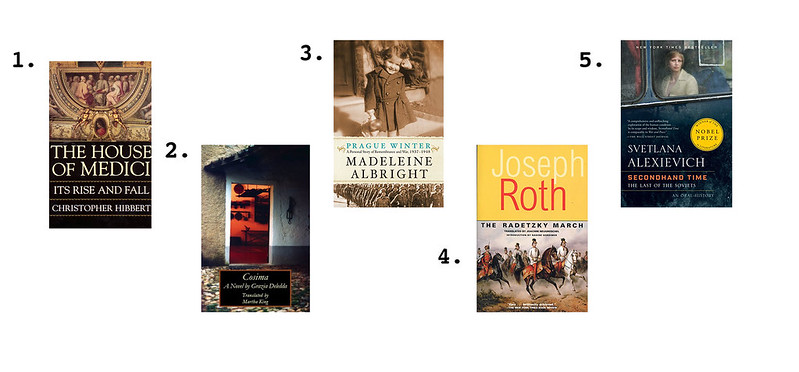
Since we planned a month long vacation before we left (and while we were "on the road") I figured it would be good to learn more about some of the places we were going.
FLORENCE
The House Of Medici: Its Rise and Fall - So much of Florence still references the Medici family (who ruled Florence for approximately 400 years, give or take) that reading a book about them gives context to the whole city - from the naming of buildings to the art in the museums. Knowing the stories made the city much more fun. (And, in retrospect, I wish I would have found books for the kids on the Medicis as well).
SARDINIA
Cosima - Other than D.H. Lawrence's The Sea and Sardinia, I had a hard time finding a good book involving the island (and I'm not a huge Lawrence fan).
Then I discovered Grazia Deledda (still totally confused why it took so long to find her, hello patriarchy). Deledda, who won the 1926 Nobel Prize in Literature (wow!!), wrote novels and stories about people on the island.
I chose to read Cosima, Deledda's semi-autobiographical novel of a little girl growing up in small town Sardinia. Cosima is both enraptured by her birthplace's beauty and frustrated by her town and family's embarrassment over her writing and creative life.
This was a really good book, I'd love to read more Deledda in the future.
PRAGUE
Prague Winter - Madeline Albrights' memoir/hisotry book tells the story of World War II through the perspective of Czechoslovakia. If you already know the history, this book may seem redundant, but I learned a lot and Albright continually asks the reader to question how they would have acted under similar circumstances.
VIENNA
The Radetzky March - As best summarized by Amazon, "The Radetzky March, Joseph Roth's classic saga of the privileged von Trotta family, encompasses the entire social fabric of the Austro-Hungarian Empire just before World War I. The author's greatest achievement, The Radetzky March is an unparalleled portrait of a civilization in decline, and as such, a universal story for our times."
At times, I found the story a little dull and the characters unbelievable. But the story itself is a good one, worth a read.
COMMUNISM
Secondhand Time, the Last of the Soviets - I must admit, I still haven't finished this book, as I find I can only read chunks at a time before I have to turn to something else. But that doesn't mean I don't love it. It's just too intense to read for long periods of time.
Svetlana Alexievich, who won the 2015 Nobel Prize for Literature, compiles her "fiction" by interviewing common people, then condensing and editing their stories. Her works are referred to as histories of emotions.
The stories are fascinating. And sad. If you want to know what life was really like under the Soviet Union, then this book is a must-read.
Just one of many great quotes, "I asked everyone I met what 'freedom' meant. Fathers and children have very different answers. Those who were born in the USSR and those born after its collapse do not share a common experience - it's like they're from different planets. For the fathers, freedom is the absence of fear . . . A man with his choice of a hundred kinds of salami is freer than one who only has ten to choose from. Freedom is never being flogged, although no generation of Russians has yet avoided a flogging. Russians don't understand freedom, they need the Cossack and the whip. For the children: Freedom is love, inner freedom is an absolute value. Freedom is when you're not afraid of your own desires; having lots of money so that you'll have everything; it's when you can live without having to think about freedom. Freedom is normal."
Labels:
Europe 2017,
Things to Read
7/27/17
Things to Read - 10 Books I Want to Read this Summer
Last year's list was a bit of a disappointment (except for Emma Cline's The Girls, which was phenomenal), but this year I'm hoping to do better. Here goes . . .
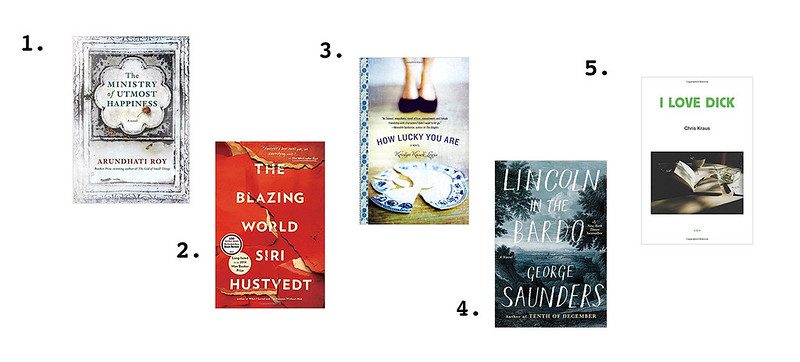
1. The Ministry of Utmost Happiness - Because I want a book that I can get lost in and this seems perfect. According to Amazon, "The Ministry of Utmost Happiness takes us on an intimate journey of many years across the Indian subcontinent—from the cramped neighborhoods of Old Delhi and the roads of the new city to the mountains and valleys of Kashmir and beyond, where war is peace and peace is war."
2. The Blazing World - Feminism and plagiarism all in one novel.
3. How Lucky You Are - So I'm super excited about this book because it sounds really good and it was written by a local. Kristyn Lewis is an Arlington mom and one of the nicest people I've met. How cool is that? Plus, it's about female friendships.
4. Lincoln in the Bardo - Truthfully, this book sounds a little too odd even for me (Lincoln in a ghost-filled purgatory), but I love George Saunders and a good friend recommended it, so I'm going to give it a try. Plus, I'm curious.
5. I Love Dick - Several of my friends raved about this TV show, but I was mixed. Yes, I love that female sexuality was the focus, but everyone was just a little too over-the-top. So now I want to read the book and compare.
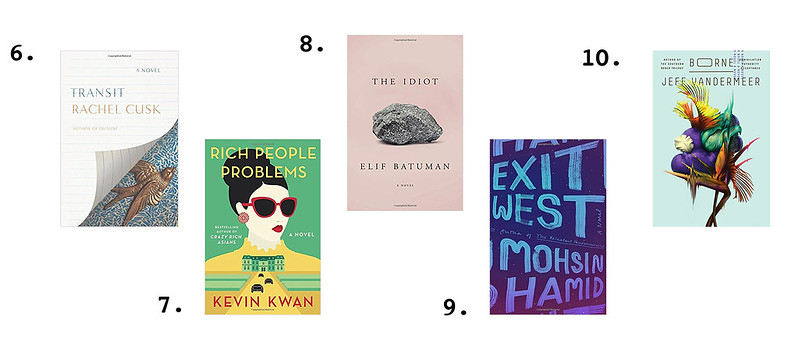
6. Transit - This is part of a trilogy that began with the book Outline (which was so good!!), I can't wait to read the newest installment.
7. Rich People Problems - Every reading list needs a guilty pleasure. Here it is.
8. The Idiot - A novel about a female artist? Count me in. Plus, critics say it is funny. And I could use something funny.
9. Exit West - Hamid's novel The Reluctant Fundamentalist was one of the best books I've read in the past few years. And this is his newest book. I'm totally excited. Plus, who doesn't love a love story?
10. Borne - A post apocalyptic novel about an animal/plant/pet. Sounds interesting.
1. The Ministry of Utmost Happiness - Because I want a book that I can get lost in and this seems perfect. According to Amazon, "The Ministry of Utmost Happiness takes us on an intimate journey of many years across the Indian subcontinent—from the cramped neighborhoods of Old Delhi and the roads of the new city to the mountains and valleys of Kashmir and beyond, where war is peace and peace is war."
2. The Blazing World - Feminism and plagiarism all in one novel.
3. How Lucky You Are - So I'm super excited about this book because it sounds really good and it was written by a local. Kristyn Lewis is an Arlington mom and one of the nicest people I've met. How cool is that? Plus, it's about female friendships.
4. Lincoln in the Bardo - Truthfully, this book sounds a little too odd even for me (Lincoln in a ghost-filled purgatory), but I love George Saunders and a good friend recommended it, so I'm going to give it a try. Plus, I'm curious.
5. I Love Dick - Several of my friends raved about this TV show, but I was mixed. Yes, I love that female sexuality was the focus, but everyone was just a little too over-the-top. So now I want to read the book and compare.
6. Transit - This is part of a trilogy that began with the book Outline (which was so good!!), I can't wait to read the newest installment.
7. Rich People Problems - Every reading list needs a guilty pleasure. Here it is.
8. The Idiot - A novel about a female artist? Count me in. Plus, critics say it is funny. And I could use something funny.
9. Exit West - Hamid's novel The Reluctant Fundamentalist was one of the best books I've read in the past few years. And this is his newest book. I'm totally excited. Plus, who doesn't love a love story?
10. Borne - A post apocalyptic novel about an animal/plant/pet. Sounds interesting.
Labels:
summer reading,
Things to Read
6/22/17
Things to Read - Three Awesome Short Story Books for Summer
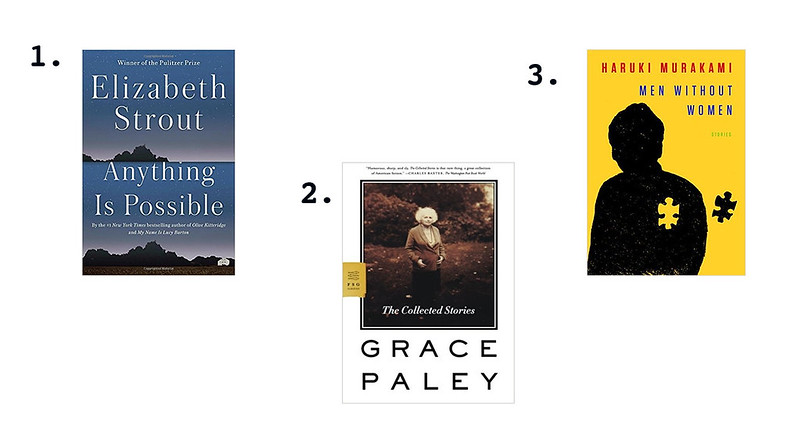
1. ANYTHING IS POSSIBLE
Elizabeth Strout's novel - My Name is Lucy Barton - was one of the best books I read this year. So when I learned that Strout wrote a follow-up short story collection centered on the small, Illinois town where Lucy grew up, I couldn't wait to read it. And the stories are wonderful. You learn about Lucy and the childhood poverty she endured, as well as more about several of the minor characters in the first novel.
Some critics have called the characters sad and lonely, but I found the collection hopeful - full of moments of surprise and beauty.
One of my favorite passages - "As Dottie thought about this, going back and forth between the kitchen and the dining room, she saw Shelly Small as a woman who suffered only from the most common complaint of all: Life simply had not been what she thought it would be. Shelly had taken life's disappointments and turned them into a house. A house the, with the clever use of the right architects, had managed to stay within the legal code yet became a monstrosity as large as Shelly's needs . . . but it had not been enough. What Dottie had not said to her, because it was not her place, was that Shelly had a husband who would break into song at the breakfast table with her in a room full of strangers sitting nearby, and that was no- excuse me, Dottie though - small thing."
2. GRACE PALEY - THE COLLECTED STORIES
I first read Grace Paley a few months ago and since then I've become obsessed. How have I never heard of her before? She's like a surreal, feminist, John Cheever. Despite the fact that Paley wrote these stories in the 1960s and 1970 many of the characters are still relatable today.
One of my favorite passages -
"He said, Tell me again. He was in a good mood. He said, You can even tell it to me twice.
I repeated the story. They all said. What?
Because it isn't usually so simple. Have you known it to happen much nowadays? A woman inside the steamy energy of middle age runs and runs. She finds the houses and streets where her childhood happened. She learns as though she was still a child what in the world is coming next."
3. MEN WITHOUT WOMEN
One of my favorite authors ever is Haruki Murakami, though in general I like his short stories more than his novels (but Norwegian Wood and Sputnik Sweetheart are so so good too). And this is the first collection he's released in the last ten years.
As described in this New Republic article, "Like Murakami’s novels, the best of these stories are beautifully, delicately unsatisfying. They shy away from resolution, leaving the reader suspended in midair. . . . The unknowability of Murakami’s characters is most effective when it hints at the mysteries of our world, when it reminds us that everyone we meet contains so many depths and contradictions that we can never fully know them."
. . . .
"Do we really need another book about men without women? I’d say that the answer is no. Even leaving Hemingway aside, at least half the literary canon is about men without women already. But stories about loneliness, about estrangement, about lack: There our appetite is endless, and Murakami offers up a new and striking way to feed it. Where Men Without Women tries to make a statement about, specifically, men and women, it fails: too self-conscious, too glib. But for people intrigued by the many facets of loss, the rest of the collection offers classic Murakami—refreshing, unusual, lustrous, with a vacancy at its heart."
Labels:
Books for Adults,
Things to Read
4/6/17
Things to Read - 6 Interesting Article From Around the Web (on Adult Friendships, The Handmaid's Tale, The Future of Not-Working, Guns Rights Advocates Meeting Gun Violence Victims, Richard Simmons, & Adjectives)
After we watched Captain Fantastic, F decided to ban the word "interesting" from daily use, because it vague and not descriptive enough. But yet I'm still going to call this random grouping of articles, "interesting", because I'm too lazy to come up with something better.
_____________
1. ADULT FRIENDSHIPS - Vox published an article that made me sad, but made so much sense - "How Our Housing Choices Make Adult Friendships More Difficult"
"[W]hen we marry and start a family, we are pushed, by custom, policy, and expectation, to move into our own houses. And when we have kids, we find ourselves tied to those houses. Many if not most neighborhoods these days are not safe for unsupervised kid frolicking. In lower-income areas there are no sidewalks; in higher-income areas there are wide streets abutted by large garages. In both cases, the neighborhoods are made for cars, not kids. So kids stay inside playing Xbox, and families don't leave except to drive somewhere.
Thus, seeing friends, even friends within "striking distance," requires planning. "We should really get together!" We say it, but we know it means calls and emails, finding an evening free of work, possibly babysitters. We know it would be fun. But it's very easy just to settle in for a little TV."
. . . .
"But it is not inevitable. In fact it's quite new! For the vast majority of Homo sapiens' history, we lived in small, nomadic bands. The tribe, not the nuclear family, was the primary unit. We lived among others of various ages, to which we were tied by generations of kinship and alliance, throughout our lives. Those are the circumstances in which our biological and neural equipment evolved.
It's only been comparatively recently (about 10,000 years ago) that we developed agriculture and started living in semi-permanent communities, more recently still that were thrown into cities, crammed up against people we barely know, and more recently still that we bounced out of cities and into suburbs."
________________
2. THE HANDMAID'S TALE - In the NY Times, Margaret Atwood reflects on the what the Handmaid's Tale means today.
"Yes, women will gang up on other women. Yes, they will accuse others to keep themselves off the hook: We see that very publicly in the age of social media, which enables group swarmings. Yes, they will gladly take positions of power over other women, even — and, possibly, especially — in systems in which women as a whole have scant power: All power is relative, and in tough times any amount is seen as better than none. Some of the controlling Aunts are true believers, and think they are doing the Handmaids a favor: At least they haven’t been sent to clean up toxic waste, and at least in this brave new world they won’t get raped, not as such, not by strangers. Some of the Aunts are sadists. Some are opportunists. And they are adept at taking some of the stated aims of 1984 feminism — like the anti-porn campaign and greater safety from sexual assault — and turning them to their own advantage. As I say: real life."
. . .
"In the wake of the recent American election, fears and anxieties proliferate. Basic civil liberties are seen as endangered, along with many of the rights for women won over the past decades, and indeed the past centuries. In this divisive climate, in which hate for many groups seems on the rise and scorn for democratic institutions is being expressed by extremists of all stripes, it is a certainty that someone, somewhere — many, I would guess — are writing down what is happening as they themselves are experiencing it. Or they will remember, and record later, if they can.
Will their messages be suppressed and hidden? Will they be found, centuries later, in an old house, behind a wall?
Let us hope it doesn’t come to that. I trust it will not."
_________________
3. THE FUTURE OF NOT-WORKING - Annie Lowry wrote another great piece for the NY Times on "The Future of Not Working," which looks at the question, "is Silicon Valley about to put the world out of work? And if so, do technologists owe the world a solution?"
"GiveDirectly wants to show the world that a basic income is a cheap, scalable way to aid the poorest people on the planet. “We have the resources to eliminate extreme poverty this year,” Michael Faye, a founder of GiveDirectly, told me. But these resources are often misallocated or wasted. His nonprofit wants to upend incumbent charities, offering major donors a platform to push money to the world’s neediest immediately and practically without cost.
What happens in this village has the potential to transform foreign-aid institutions, but its effects might also be felt closer to home. A growing crowd, including many of GiveDirectly’s backers in Silicon Valley, are looking at this pilot project not just as a means of charity but also as the groundwork for an argument that a universal basic income might be right for you, me and everyone else around the world too."
_________________
4. GUN RIGHTS ACTIVISTS MEET VICTIMS OF GUN VIOLENCE - In an "Experiment in Empathy" New York Magazine asks the question "He auctioned off the pistol that killed Trayvon Martin. She watched her child die in a mass shooting. Can they change each other’s minds about guns?" (Be prepared to cry while reading this one).
"Todd and Carolyn proved that radical empathy is at least possible. They were shape-shifters. They became each other. And in that moment, the videographers were crying. The organizers, who have seen versions of this a hundred times before, were crying. No one in the room that day will ever forget what they saw.
In that moment, the commonality of experience, the universality of human vulnerability, had been so obvious — and so breathtaking. Everyone in the room was separated not by a deep canyon but by a thin line. The dividing factor wasn’t really beliefs about gun control; it was about fear and how you respond to it. There were those who held to their gun ownership as an instrument of power and security in a world that too often seemed unsafe and uncertain, and there were those who knew too well that nothing on earth can guarantee safety and certainty for the people you love. They had lived through what the others so desperately feared. As David Peters, the former Marine, put it, “Am I safe or am I not safe?” That is, at some very basic level, always the question. No one quite knew where to go from there, but it seemed promising, this collective realization that all of their beliefs were coming from essentially the same human place.
But when the participants regathered after a break, it was as if a spell had been broken, as if this group, which had forged a fragile unity through vulnerability, couldn’t sustain so much heartbreak. Everyone was tired. They had tarried long enough in alternate realities."
________________
5. RICHARD SIMMONS AND LIFE IN THE PUBLIC EYE - NPR has a great piece about the podcast Missing Richard Simmons (which I haven't heard) and the nature of being "known".
"I don't really believe in the old Andy Warhol prediction that in the future, everyone will be famous for 15 minutes. What I believe is that fame will indeed be served in small portions, limited not by time but by scope. If that's the case, then instead of being famous for 15 minutes, many will be famous to 15 people. Or perhaps 1,500 or 15,000 people — a small enough number that you can move through most of the world unnoticed, but a large enough number that the circle of people who follow you with intensity necessarily includes people who don't know you. What to do about that is something I think more and more people have faced.
. . . .
There is only so much energy. There is only so much to give, and there is only so much you can turn yourself inside out for so many people before something runs low, or runs out.
. . . .
Some thank-you's arrive written on rocks, and if you feel obligated to carry all of those rocks everywhere you go for the rest of your life, if you can't learn to look at them, be grateful for them, and set them down, even they become a lot to carry.
The more the gratitude is for what has already been done, the more it is written on paper: I'm so grateful for the thing you made; it meant the world to me. That is weightless; it is wonderful. The closer it gets to expecting something from you in the future, something that must continue, the more it is written on stone: You're the only one who understands me. You're the only reason I can get out of bed every day. I have a feeling Richard Simmons received a lot of gratitude written on stones, just as Judy Blume did, but it certainly sounds like it was much harder for him to put down."
________________
6. THE PERSON WITH THE POWER TAKES THE NOUN - And, last but not least, Gloria Steinem on "Women Have Chick Flicks, What About Men?"
"Indeed, as long as men are taken seriously when they write about the female half of the world — and women are not taken seriously when writing about ourselves, much less about men and public affairs — the list of Great Authors will be more about power than talent, more about opinion than experience.
[Regarding the male equivalent of "chick flicks"], I realized the problem began with the fact that adjectives are mostly required of the less powerful. Thus, there are “novelists” and “female novelists,” “African-American doctors” but not “European- American doctors,” “gay soldiers” but not “heterosexual soldiers,” “transgender activists” but not “cisgender activists.”
As has been true forever, the person with the power takes the noun — and the norm — while the less powerful requires an adjective."
_____________
1. ADULT FRIENDSHIPS - Vox published an article that made me sad, but made so much sense - "How Our Housing Choices Make Adult Friendships More Difficult"
"[W]hen we marry and start a family, we are pushed, by custom, policy, and expectation, to move into our own houses. And when we have kids, we find ourselves tied to those houses. Many if not most neighborhoods these days are not safe for unsupervised kid frolicking. In lower-income areas there are no sidewalks; in higher-income areas there are wide streets abutted by large garages. In both cases, the neighborhoods are made for cars, not kids. So kids stay inside playing Xbox, and families don't leave except to drive somewhere.
Thus, seeing friends, even friends within "striking distance," requires planning. "We should really get together!" We say it, but we know it means calls and emails, finding an evening free of work, possibly babysitters. We know it would be fun. But it's very easy just to settle in for a little TV."
. . . .
"But it is not inevitable. In fact it's quite new! For the vast majority of Homo sapiens' history, we lived in small, nomadic bands. The tribe, not the nuclear family, was the primary unit. We lived among others of various ages, to which we were tied by generations of kinship and alliance, throughout our lives. Those are the circumstances in which our biological and neural equipment evolved.
It's only been comparatively recently (about 10,000 years ago) that we developed agriculture and started living in semi-permanent communities, more recently still that were thrown into cities, crammed up against people we barely know, and more recently still that we bounced out of cities and into suburbs."
________________
2. THE HANDMAID'S TALE - In the NY Times, Margaret Atwood reflects on the what the Handmaid's Tale means today.
"Yes, women will gang up on other women. Yes, they will accuse others to keep themselves off the hook: We see that very publicly in the age of social media, which enables group swarmings. Yes, they will gladly take positions of power over other women, even — and, possibly, especially — in systems in which women as a whole have scant power: All power is relative, and in tough times any amount is seen as better than none. Some of the controlling Aunts are true believers, and think they are doing the Handmaids a favor: At least they haven’t been sent to clean up toxic waste, and at least in this brave new world they won’t get raped, not as such, not by strangers. Some of the Aunts are sadists. Some are opportunists. And they are adept at taking some of the stated aims of 1984 feminism — like the anti-porn campaign and greater safety from sexual assault — and turning them to their own advantage. As I say: real life."
. . .
"In the wake of the recent American election, fears and anxieties proliferate. Basic civil liberties are seen as endangered, along with many of the rights for women won over the past decades, and indeed the past centuries. In this divisive climate, in which hate for many groups seems on the rise and scorn for democratic institutions is being expressed by extremists of all stripes, it is a certainty that someone, somewhere — many, I would guess — are writing down what is happening as they themselves are experiencing it. Or they will remember, and record later, if they can.
Will their messages be suppressed and hidden? Will they be found, centuries later, in an old house, behind a wall?
Let us hope it doesn’t come to that. I trust it will not."
_________________
3. THE FUTURE OF NOT-WORKING - Annie Lowry wrote another great piece for the NY Times on "The Future of Not Working," which looks at the question, "is Silicon Valley about to put the world out of work? And if so, do technologists owe the world a solution?"
"GiveDirectly wants to show the world that a basic income is a cheap, scalable way to aid the poorest people on the planet. “We have the resources to eliminate extreme poverty this year,” Michael Faye, a founder of GiveDirectly, told me. But these resources are often misallocated or wasted. His nonprofit wants to upend incumbent charities, offering major donors a platform to push money to the world’s neediest immediately and practically without cost.
What happens in this village has the potential to transform foreign-aid institutions, but its effects might also be felt closer to home. A growing crowd, including many of GiveDirectly’s backers in Silicon Valley, are looking at this pilot project not just as a means of charity but also as the groundwork for an argument that a universal basic income might be right for you, me and everyone else around the world too."
_________________
4. GUN RIGHTS ACTIVISTS MEET VICTIMS OF GUN VIOLENCE - In an "Experiment in Empathy" New York Magazine asks the question "He auctioned off the pistol that killed Trayvon Martin. She watched her child die in a mass shooting. Can they change each other’s minds about guns?" (Be prepared to cry while reading this one).
"Todd and Carolyn proved that radical empathy is at least possible. They were shape-shifters. They became each other. And in that moment, the videographers were crying. The organizers, who have seen versions of this a hundred times before, were crying. No one in the room that day will ever forget what they saw.
In that moment, the commonality of experience, the universality of human vulnerability, had been so obvious — and so breathtaking. Everyone in the room was separated not by a deep canyon but by a thin line. The dividing factor wasn’t really beliefs about gun control; it was about fear and how you respond to it. There were those who held to their gun ownership as an instrument of power and security in a world that too often seemed unsafe and uncertain, and there were those who knew too well that nothing on earth can guarantee safety and certainty for the people you love. They had lived through what the others so desperately feared. As David Peters, the former Marine, put it, “Am I safe or am I not safe?” That is, at some very basic level, always the question. No one quite knew where to go from there, but it seemed promising, this collective realization that all of their beliefs were coming from essentially the same human place.
But when the participants regathered after a break, it was as if a spell had been broken, as if this group, which had forged a fragile unity through vulnerability, couldn’t sustain so much heartbreak. Everyone was tired. They had tarried long enough in alternate realities."
________________
5. RICHARD SIMMONS AND LIFE IN THE PUBLIC EYE - NPR has a great piece about the podcast Missing Richard Simmons (which I haven't heard) and the nature of being "known".
"I don't really believe in the old Andy Warhol prediction that in the future, everyone will be famous for 15 minutes. What I believe is that fame will indeed be served in small portions, limited not by time but by scope. If that's the case, then instead of being famous for 15 minutes, many will be famous to 15 people. Or perhaps 1,500 or 15,000 people — a small enough number that you can move through most of the world unnoticed, but a large enough number that the circle of people who follow you with intensity necessarily includes people who don't know you. What to do about that is something I think more and more people have faced.
. . . .
There is only so much energy. There is only so much to give, and there is only so much you can turn yourself inside out for so many people before something runs low, or runs out.
. . . .
Some thank-you's arrive written on rocks, and if you feel obligated to carry all of those rocks everywhere you go for the rest of your life, if you can't learn to look at them, be grateful for them, and set them down, even they become a lot to carry.
The more the gratitude is for what has already been done, the more it is written on paper: I'm so grateful for the thing you made; it meant the world to me. That is weightless; it is wonderful. The closer it gets to expecting something from you in the future, something that must continue, the more it is written on stone: You're the only one who understands me. You're the only reason I can get out of bed every day. I have a feeling Richard Simmons received a lot of gratitude written on stones, just as Judy Blume did, but it certainly sounds like it was much harder for him to put down."
________________
6. THE PERSON WITH THE POWER TAKES THE NOUN - And, last but not least, Gloria Steinem on "Women Have Chick Flicks, What About Men?"
"Indeed, as long as men are taken seriously when they write about the female half of the world — and women are not taken seriously when writing about ourselves, much less about men and public affairs — the list of Great Authors will be more about power than talent, more about opinion than experience.
[Regarding the male equivalent of "chick flicks"], I realized the problem began with the fact that adjectives are mostly required of the less powerful. Thus, there are “novelists” and “female novelists,” “African-American doctors” but not “European- American doctors,” “gay soldiers” but not “heterosexual soldiers,” “transgender activists” but not “cisgender activists.”
As has been true forever, the person with the power takes the noun — and the norm — while the less powerful requires an adjective."
3/9/17
Things to Read - Four Great (and Totally Different) Books
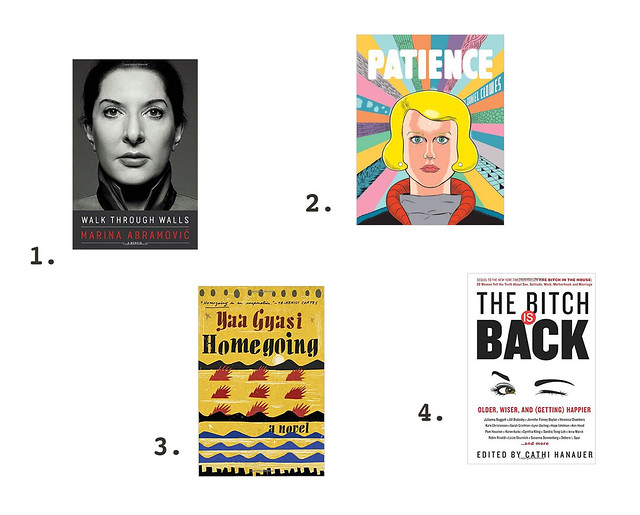
Remember a few weeks ago when I mentioned that in 2016 I read some duds? Well, so far 2017 has been way way better - there are so many books that I can't say enough good things about. So even if the country is falling apart, at least the diversions listed below will keep you entertained during America's demise.
1. Walk Through Walls by Marina Abramovic (memoir)
I've been intrigued by Abramovic ever since watching The Artist is Present - a documentary about her retrospective at MOMA - and her memoir doesn't disappoint. I loved Abramovic's vivid descriptions of growing up in Communist Yugoslavia, as well as how she became a performance artist and the inspirations behind many of her key works.
Though I find some of Abramovic's work bizarre - such as "[s]omeone stuck pins into me. Someone else slowly poured a glass of water over my head. Someone cut my neck with the knife and sucked the blood. I still have the scar." - I admire her dedication and creativity. Plus, whenever I walk in a museum, I always wonder about each artist's path to fame, so I enjoyed how Abramovic takes you through her years as a starving artist performing in galleries to an icon.
2. Patience by Daniel Clowes (graphic novel)
As you've probably realized, lately I'm a little obsessed with graphic novels. Patience is odd and quirky and over-the-top - time-travel, murder, true love, weird blue people from the future, etc. But I couldn't put it down. Literally, I read it straight through in one (long) sitting.
3. Homegoing by Yaa Gyasi (fiction)
This novel begins in late-1700s Africa with the separation of two half-sisters - one who leaves for America on a slave ship and one who becomes the wife of a white slave trader. Each chapter of Homegoing continues the family tree by telling the story of a new generation (the novel spans seven generations in total). While some chapters are stronger than others, most of the characters are so real that I felt sad when their stories ended and a new generation was introduced. All in all a fantastic book.
4. The Bitch is Back: Older, Wiser, and (Getting) Happier (essays)
My friend Carolyn compared this book to "sitting down for long lovely chats with friends over coffee or wine and chocolate, and listening to their stories." I was a little nervous the essays would be negative or spiteful, but instead they are so varied and diverse (and, for the most part, positive) that reading them makes me feel like part of a community - one that I didn't even know I needed, but that I'm so glad I found.
Labels:
Books for Adults,
Things to Read
2/1/17
Things to Read - 10 Books I Want to Read This Winter
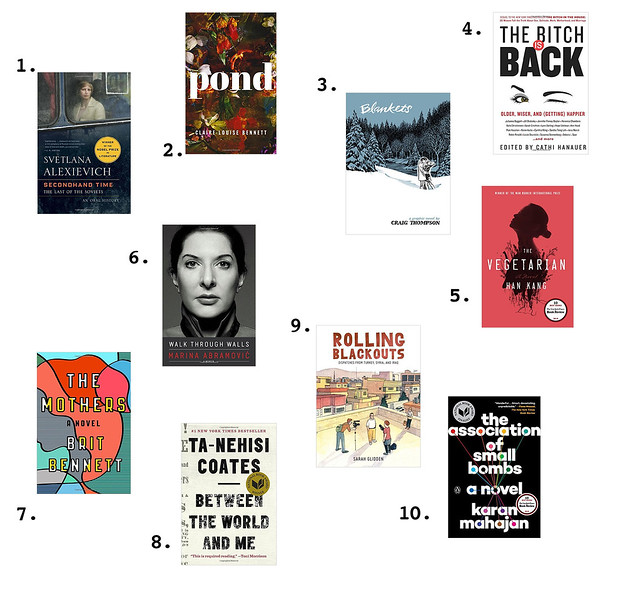
So I read some bad books in 2016, but this year will be different. I think. Here's the list. Fingers crossed it is a good one!
1. Secondhand Time: The Last of the Soviets - Because the Nobel Prize. And Russia.
2. Pond - Because unusual. From Buzzfeed, "Pond provides one of the great pleasures of fiction: really getting into someone else’s mind and finding it both mundane and weirder than imaginable. Narrated by a woman living alone in a small, bucolic town, Pond concerns itself with the stuff of daily life—gardening, oven knobs, dinner parties, neighbors — yet renders these things strange, new, and bewitching through the fascinating perspective of the narrator."
3. Blankets - Because this graphic novel looks so so pretty.
4. The Bitch Is Back: Older, Wiser, and (Getting) Happier - Because "25 women discussing love, sex, work, family, independence, body-image, health, and aging" sounds incredible!
5. The Vegetarian - Because weird. From Amazon, "Before the nightmares began, Yeong-hye and her husband lived an ordinary, controlled life. But the dreams—invasive images of blood and brutality—torture her, driving Yeong-hye to purge her mind and renounce eating meat altogether. It’s a small act of independence, but it interrupts her marriage and sets into motion an increasingly grotesque chain of events at home. As her husband, her brother-in-law and sister each fight to reassert their control, Yeong-hye obsessively defends the choice that’s become sacred to her. Soon their attempts turn desperate, subjecting first her mind, and then her body, to ever more intrusive and perverse violations, sending Yeong-hye spiraling into a dangerous, bizarre estrangement, not only from those closest to her, but also from herself."
6. Walk Through Walls: A Memoir - Because Marina Abramović's performance art is so unique (have you seen the documentary about her on Netflix?)
7. The Mothers - Because several critics listed this as one of the best books of the year. Plus, my friend Deb said it was good and her recommendations are always the best.
8. Between the World and Me - Because I'm embarrassed I haven't read this yet.
9. Rolling Blackouts: Dispatches from Turkey, Syria, and Iraq - Because I loved Jerusalem so I want to read more graphic novels about far away places.
10. An Association of Small Bombs - Because critics loved it. And hopefully they're right.
Labels:
Books for Adults,
Things to Read
1/12/17
Things to Read - Jerusalem

Lately I've read/attempted to read a string of bad books. I'm not sure what the problem is - whether age is making me more finicky or whether publishing standards just aren't what they used to be. But all in all, I've been less than thrilled.
So when I stumbled across Guy Delisle's Jerusalem: Chronicles from the Holy City in the library one day, my only goal was to remove myself from the boring fiction comfort zone I'd fallen into and hopefully break my book rut. Instead, I sort of fell in love with this book.
I've always been somewhat fascinated by Jerusalem (isn't everyone?), but also incredibly confused by it (so. many. people. not. getting. along.). And as someone who doesn't practice organized religion, it felt like a place where I didn't belong (spoiler alert - it still feels this way).
Luckily for me, Delisle is also a non-believer. Rather than arrive for religious or political reasons, he lived in Jerusalem because his girlfriend, an employee of Doctor's Without Borders, worked there (hence the book is also a great memoir of Delisle's life as a stay-at-home parent of two children/writer).
Delisle's beautifully illustrated memoir showcases the city's beauty, frustrations, and conflicts (SO MANY CONFLICTS!). Especially all of his drawings of the wall. And it's a pleasure to read. The kind of book that makes you cancel your afternoon plans in order to spend a few more hours on the couch.
Delisle has also written other memoirs about his time in North Korea and Burma, which I can't wait to read as well.
11/17/16
Things to Read - Eight Interesting Articles From Around the Web - NONE OF WHICH DEAL WITH THE ELECTION!!
(1) ENGLISH MAJORS - As a chemist turned lawyer turned photographer, Steven Pearlstein's Washington Post editorial, Meet the Parents Who Won't Let Their Children Study Literature, really spoke to me (and reminded me that I have to step back and let my kids make their own paths.
"You might not expect college freshmen to understand that careers don’t proceed in straight lines, but surely their parents ought to. In the real world, most physics majors don’t become physicists, most psychology majors don’t become psychologists, and most English majors don’t become writers or teachers. You’ll find a surprising number of philosophy majors at hedge funds and lots of political-science majors at law firms. I was an American studies major. Among chief executives of the largest corporations, there are roughly as many engineers and liberal arts majors, in total, as there are undergraduate majors in business, accounting and economics combined. Indeed, one study found that only 27 percent of people have jobs that are substantially related to their college majors — a reality that applies even to the STEM fields. “Choosing a major is not choosing a career,” says Jeff Selingo, author of “There Is Life After College.”
. . .
It’s worth remembering that at American universities, the original rationale for majors was not to train students for careers. Rather, the idea was that after a period of broad intellectual exploration, a major was supposed to give students the experience of mastering one subject, in the process developing skills such as discipline, persistence, and how to research, analyze, communicate clearly and think logically.
As it happens, those are precisely the skills business executives still say they want from college graduates — although, to be fair, that has not always been communicated to their human-resource departments or the computers they use to sort through résumés. A study for the Association of American Colleges and Universities found that 93 percent of employers agreed that a “demonstrated capacity to think critically, communicate clearly, and solve complex problems is more important than [a job candidate’s] undergraduate major.”
___________________________________
(2) HOUSEKEEPING - I loved Rachel Cusk's "Making House: Notes on Domesticity." (And thank you to Julia's Bookbag for the recommendation).
"Like the body itself, a home is something both looked at and lived in, a duality that in neither case I have managed to reconcile. I retain the belief that other people’s homes are real where mine is a fabrication, just as I imagine others to live inner lives less flawed than my own. And like my daughter, I, too, used to prefer other people’s houses, though I am old enough now to know that, given a choice, there is always a degree of design in the way that people live. The man who admired my peeling Formica was crediting me with, or accusing me of, doing something deliberate, and I don’t doubt that the apparent artlessness of my daughter’s adopted household is, however half-consciously, a result of a carefully considered set of convictions. That those convictions so closely echo my own makes the illusion — if illusion it is — more tantalizing still.
Entering a house, I often feel that I am entering a woman’s body, and that everything I do there will be felt more intimately by her than by anyone else. But in that house it is possible to forget entirely — as the passengers on the top deck of a liner can forget the blackened, bellowing engine room below — what is surely nonetheless true: that a home is powered by a woman’s will and work, and that a curious form of success could be measured in her ability to suggest the opposite. I can’t see any difference, in my daughter’s adopted household, between what it is and what it seems to be — the home of a kind, artistic and educated woman — and yet I find myself unable to believe that difference isn’t there."
____________________
(3) CAREGIVERS - Anne Marie-Slaughter has moved from saying mothers can't have it all to arguing that nobody can.
". . . the biggest change came when Slaughter’s husband’s aunt sent her a small book called “On Caring.” Published in 1971 by American philosopher Milton Mayeroff, the book is a treatise on caring for others as the foundational work of society.
“It was like, wow, this is about investing in others. And this is a set of skills,” Slaughter recalls. “That was the moment I was like, ‘Whoa, whoa, whoa, there’s a big idea here.’ ”
Slaughter’s book, “Unfinished Business,” which is out in paperback this month, hasn’t reached nearly as many readers as the Atlantic article but approaches the topic with much more nuance. She argues that across the board, we give caregivers the shaft, dismissing stay-at-home parents at dinner parties, barely paying nannies a living wage and punishing those who take career breaks to focus on family with a challenging on-ramp back to the professional world. We have no national standard for paid parental leave or universal child care.
But she doesn’t define this simply as a woman’s issue. Slaughter heard from enough men to see an often overlooked end of the equation: that the pressure to be the breadwinner comes at the expense of time and relationships with family.
_____________________________
(4) - THE NOVELIST DISGUISED AS A HOUSEWIFE - New York Magazine's profile of Shirley Jackson, entitled "The Novelist Disguised as a Housewife", made me want to read more of her work.
Jackson often complained about the mental calisthenics required to be at once a mother and a writer — the “nagging thoughts” about finishing the laundry or preparing meals that often interrupted her creative work. When she was working on a novel, she once wrote to a friend, she preferred to “lock myself up in my cave for four dogged hours a day, and sneak a minute or so here and there for writing letters and making lunch (‘You will eat vegetable soup again today and like it; Mommy’s beginning chapter three’).” But many writers, especially women writers, learn to derive imaginative energy from their constraints. Alice Munro has said that she began writing short stories because as a young mother she had no time to write novels: “When you are responsible for running a house and taking care of small children, particularly in the days before disposable diapers or ubiquitous automatic washing machines, it’s hard to arrange for large chunks of time.”
. . . .
The housewife role also provided Jackson with a form of camouflage. Bowing to stereotypes, she preferred to present herself to reporters and critics — virtually all of whom were men — as a women’s-magazine-certified happy homemaker who tossed off her stories during breaks from dusting. “I can’t persuade myself … that writing is honest work,” she said cheerily in an interview with Harvey Breit of The New York Times Book Review. “Fifty percent of my life is spent washing and dressing the children, cooking, washing dishes and clothes, and mending. After I get it all to bed, I turn around to my typewriter and try to — well, create concrete things again.” The pose sometimes worked too well. In The Feminine Mystique, Betty Friedan myopically criticized Jackson as part of “a new breed of women writers” who wrote about themselves as if they were “‘just housewives,’ reveling in a comic world of children’s pranks and eccentric washing machines and Parents’ Night at the PTA.”
_______________________
(5) GROWING UP AS A WHITE NATIONALIST - The White Flight of Derek Black in the Washington Post is a must read on the "family" of racial supremacy. It is hard to excerpt, so if you have time, try to read the whole story.
"White nationalism had bullied its way toward the very center of American politics, and yet, one of the people who knew the ideology best was no longer anywhere near that center. Derek had just turned 27, and instead of leading the movement, he was trying to untangle himself not only from the national moment but also from a life he no longer understood.
From the very beginning, that life had taken place within the insular world of white nationalism, where there was never any doubt about what whiteness could mean in the United States. Derek had been taught that America was intended as a place for white Europeans and that everyone else would eventually have to leave. He was told to be suspicious of other races, of the U.S. government, of tap water and of pop culture."
________________
(6) - PERFECT HOMES - I seem to be smitten with articles about the home lately - Kim France wrote an excellent essay on the difference between a place you live and a home entitled "This Is Not My Beautiful House."
"I felt fortunate to live in rooms that were so beautifully composed. It was all completely my taste, but nothing I could ever had conjured myself, and it felt like such a cool trick that you could actually pay somebody to do that for you.
Less cool, unfortunately, was actual life in the Brooklyn house. The first problem was the place itself. There was so much room — too much room for two people by far — and yet there was not one spot in the entire house that felt comfortable or warm to me. Like home. The living room was beautiful, but the real thoroughfare of the house was the ground floor, and somehow, traveling up a floor to relax after work, instead of just plopping down at the kitchen table — with its stylish-but-none-too-comfortable midcentury chairs — never felt quite intuitive. The red room was dead space — the books lived there, but aside from that, there was really no reason to ever enter it. One afternoon, my husband settled into the womb chair to read a New Yorker, and that New Yorker stayed on stool next to the chair for the next six months."
. . . .
A few years after selling the house, I received a package at work. It was the bon vivant’s first coffee table book, warmly signed. I was giving it a quick flip-through when I saw something that looked awfully familiar: it was the red room from the brownstone in Brooklyn. And on the facing page, my old living room, with the two long, low sofas and the African gourd lamps. For a moment, I hadn’t recognized those pictures as my home, the place where I had lived while I was still married. The rooms had never felt particularly warm, and here they looked especially vacant: of any soul, all memories. I remembered how naked I felt when buyers came to tour the house once we put it up for sale; how obvious it was that the life of a typical Brooklyn family was not being lived there — that the three small bedrooms on the top floor hadn’t been filled with children and wouldn’t be — and I felt, for a moment, naked once more. But of course it was nothing the casual reader would ever pick up on, and that’s when I realized that a spell had been lifted: never again would I envy the lives of people whose homes I saw in books or magazines, no matter how perfect they may have appeared. Because mine looked pretty nice in those pages too."
_______________
(7) LEONARD COHEN - The New Yorker's profile of Lenoard Cohen is INCREDIBLE, since reading it I've played Cohen constantly.
"Leonard Cohen lives on the second floor of a modest house in Mid-Wilshire, a diverse, unglamorous precinct of Los Angeles. He is eighty-two. Between 2008 and 2013, he was on tour more or less continuously. It is highly unlikely that his health will permit such rigors ever again. Cohen has an album coming out in October—obsessed with mortality, God-infused, yet funny, called “You Want It Darker”—but friends and musical associates say they’d be surprised to see him onstage again except in a limited way: a single performance, perhaps, or a short residency at one venue. When I e-mailed ahead to ask Cohen out for dinner, he said that he was more or less “confined to barracks.”
. . . .
There is probably no more touring ahead. What is on Cohen’s mind now is family, friends, and the work at hand. “I’ve had a family to support, so there’s no sense of virtue attached to it,” he said. “I’ve never sold widely enough to be able to relax about money. I had two kids and their mother to support and my own life. So there was never an option of cutting out. Now it’s a habit. And there’s the element of time, which is powerful, with its incentive to finish up. Now I haven’t gotten near finishing up. I’ve finished up a few things. I don’t know how many other things I’ll be able to get to, because at this particular stage I experience deep fatigue. . . . There are times when I just have to lie down. I can’t play anymore, and my back goes fast also. Spiritual things, baruch Hashem”—thank God—“have fallen into place, for which I am deeply grateful.”
Cohen has unpublished poems to arrange, unfinished lyrics to finish and record or publish. He’s considering doing a book in which poems, like pages of the Talmud, are surrounded by passages of interpretation.
“The big change is the proximity to death,” he said. “I am a tidy kind of guy. I like to tie up the strings if I can. If I can’t, also, that’s O.K. But my natural thrust is to finish things that I’ve begun.”
_______________________
(8) LIFE ATER BALLET - Elle Magazine's "The Afterlife of a Ballerina", profiles Alexandra Ansanelli. "At age 16, Alexandra Ansanelli was anointed a prodigy. By 22, she was a principal for the New York City Ballet. At 26, she was a principal for the Royal Ballet. By 28, she had given it all up."
"We know of no other occupation that requires such extensive training, that is held in such esteem as a contribution to culture, and that pays so little," the authors of the 2004 survey write. Even during peak earning years: in the U.S., an average dancer's annual total income is just $35,000—about half of which comes from non-dance activities. Even stars might not earn much more, or find themselves better equipped for life on the outside. After his body gave out in his late thirties, Edward Villella—a star at New York City Ballet in the 1950s and '60s, who had danced for four presidents—lived for a while on $5 a week.
. . . .
At 35, Alexandra has only recently come to a realization that most of us are forced to reckon with much, much earlier: "You can try to do everything right and it still may not work." Though she spends many of her days in an office, she says she's not an office person. Learning to communicate verbally has been a challenge. "I didn't realize how introverted I was. I had been so used to emoting silently and physically." Nonetheless, she is seemingly ahead of many of her peers. She is aware of the limitations that her career imposed, and actively working to overcome them.
When I ask her how her personal life has changed, she answers, "It exists now." But it's hard to catch up on everything her peers went through as teenagers and young adults. "I feel I'm learning all the time, what to do, what not to do." She worries about what new acquaintances will think of her past. "It's freaky to a lot of people," the way she left her career. "Did she have some kind of mental breakdown?" she imagines they wonder.
She wants a serious relationship; both of her sisters are married. She's tried Tinder and recently joined Bumble. For obvious reasons, she doesn't like the apps that make you fill in your whole biography. Does she miss her old life—the drama, the spotlight? "I don't think real life has enough glamour," she says. But she also says that she doesn't think glamour is "enough to base your life on."
"You might not expect college freshmen to understand that careers don’t proceed in straight lines, but surely their parents ought to. In the real world, most physics majors don’t become physicists, most psychology majors don’t become psychologists, and most English majors don’t become writers or teachers. You’ll find a surprising number of philosophy majors at hedge funds and lots of political-science majors at law firms. I was an American studies major. Among chief executives of the largest corporations, there are roughly as many engineers and liberal arts majors, in total, as there are undergraduate majors in business, accounting and economics combined. Indeed, one study found that only 27 percent of people have jobs that are substantially related to their college majors — a reality that applies even to the STEM fields. “Choosing a major is not choosing a career,” says Jeff Selingo, author of “There Is Life After College.”
. . .
It’s worth remembering that at American universities, the original rationale for majors was not to train students for careers. Rather, the idea was that after a period of broad intellectual exploration, a major was supposed to give students the experience of mastering one subject, in the process developing skills such as discipline, persistence, and how to research, analyze, communicate clearly and think logically.
As it happens, those are precisely the skills business executives still say they want from college graduates — although, to be fair, that has not always been communicated to their human-resource departments or the computers they use to sort through résumés. A study for the Association of American Colleges and Universities found that 93 percent of employers agreed that a “demonstrated capacity to think critically, communicate clearly, and solve complex problems is more important than [a job candidate’s] undergraduate major.”
___________________________________
(2) HOUSEKEEPING - I loved Rachel Cusk's "Making House: Notes on Domesticity." (And thank you to Julia's Bookbag for the recommendation).
"Like the body itself, a home is something both looked at and lived in, a duality that in neither case I have managed to reconcile. I retain the belief that other people’s homes are real where mine is a fabrication, just as I imagine others to live inner lives less flawed than my own. And like my daughter, I, too, used to prefer other people’s houses, though I am old enough now to know that, given a choice, there is always a degree of design in the way that people live. The man who admired my peeling Formica was crediting me with, or accusing me of, doing something deliberate, and I don’t doubt that the apparent artlessness of my daughter’s adopted household is, however half-consciously, a result of a carefully considered set of convictions. That those convictions so closely echo my own makes the illusion — if illusion it is — more tantalizing still.
Entering a house, I often feel that I am entering a woman’s body, and that everything I do there will be felt more intimately by her than by anyone else. But in that house it is possible to forget entirely — as the passengers on the top deck of a liner can forget the blackened, bellowing engine room below — what is surely nonetheless true: that a home is powered by a woman’s will and work, and that a curious form of success could be measured in her ability to suggest the opposite. I can’t see any difference, in my daughter’s adopted household, between what it is and what it seems to be — the home of a kind, artistic and educated woman — and yet I find myself unable to believe that difference isn’t there."
____________________
(3) CAREGIVERS - Anne Marie-Slaughter has moved from saying mothers can't have it all to arguing that nobody can.
". . . the biggest change came when Slaughter’s husband’s aunt sent her a small book called “On Caring.” Published in 1971 by American philosopher Milton Mayeroff, the book is a treatise on caring for others as the foundational work of society.
“It was like, wow, this is about investing in others. And this is a set of skills,” Slaughter recalls. “That was the moment I was like, ‘Whoa, whoa, whoa, there’s a big idea here.’ ”
Slaughter’s book, “Unfinished Business,” which is out in paperback this month, hasn’t reached nearly as many readers as the Atlantic article but approaches the topic with much more nuance. She argues that across the board, we give caregivers the shaft, dismissing stay-at-home parents at dinner parties, barely paying nannies a living wage and punishing those who take career breaks to focus on family with a challenging on-ramp back to the professional world. We have no national standard for paid parental leave or universal child care.
But she doesn’t define this simply as a woman’s issue. Slaughter heard from enough men to see an often overlooked end of the equation: that the pressure to be the breadwinner comes at the expense of time and relationships with family.
_____________________________
(4) - THE NOVELIST DISGUISED AS A HOUSEWIFE - New York Magazine's profile of Shirley Jackson, entitled "The Novelist Disguised as a Housewife", made me want to read more of her work.
Jackson often complained about the mental calisthenics required to be at once a mother and a writer — the “nagging thoughts” about finishing the laundry or preparing meals that often interrupted her creative work. When she was working on a novel, she once wrote to a friend, she preferred to “lock myself up in my cave for four dogged hours a day, and sneak a minute or so here and there for writing letters and making lunch (‘You will eat vegetable soup again today and like it; Mommy’s beginning chapter three’).” But many writers, especially women writers, learn to derive imaginative energy from their constraints. Alice Munro has said that she began writing short stories because as a young mother she had no time to write novels: “When you are responsible for running a house and taking care of small children, particularly in the days before disposable diapers or ubiquitous automatic washing machines, it’s hard to arrange for large chunks of time.”
. . . .
The housewife role also provided Jackson with a form of camouflage. Bowing to stereotypes, she preferred to present herself to reporters and critics — virtually all of whom were men — as a women’s-magazine-certified happy homemaker who tossed off her stories during breaks from dusting. “I can’t persuade myself … that writing is honest work,” she said cheerily in an interview with Harvey Breit of The New York Times Book Review. “Fifty percent of my life is spent washing and dressing the children, cooking, washing dishes and clothes, and mending. After I get it all to bed, I turn around to my typewriter and try to — well, create concrete things again.” The pose sometimes worked too well. In The Feminine Mystique, Betty Friedan myopically criticized Jackson as part of “a new breed of women writers” who wrote about themselves as if they were “‘just housewives,’ reveling in a comic world of children’s pranks and eccentric washing machines and Parents’ Night at the PTA.”
_______________________
(5) GROWING UP AS A WHITE NATIONALIST - The White Flight of Derek Black in the Washington Post is a must read on the "family" of racial supremacy. It is hard to excerpt, so if you have time, try to read the whole story.
"White nationalism had bullied its way toward the very center of American politics, and yet, one of the people who knew the ideology best was no longer anywhere near that center. Derek had just turned 27, and instead of leading the movement, he was trying to untangle himself not only from the national moment but also from a life he no longer understood.
From the very beginning, that life had taken place within the insular world of white nationalism, where there was never any doubt about what whiteness could mean in the United States. Derek had been taught that America was intended as a place for white Europeans and that everyone else would eventually have to leave. He was told to be suspicious of other races, of the U.S. government, of tap water and of pop culture."
________________
(6) - PERFECT HOMES - I seem to be smitten with articles about the home lately - Kim France wrote an excellent essay on the difference between a place you live and a home entitled "This Is Not My Beautiful House."
"I felt fortunate to live in rooms that were so beautifully composed. It was all completely my taste, but nothing I could ever had conjured myself, and it felt like such a cool trick that you could actually pay somebody to do that for you.
Less cool, unfortunately, was actual life in the Brooklyn house. The first problem was the place itself. There was so much room — too much room for two people by far — and yet there was not one spot in the entire house that felt comfortable or warm to me. Like home. The living room was beautiful, but the real thoroughfare of the house was the ground floor, and somehow, traveling up a floor to relax after work, instead of just plopping down at the kitchen table — with its stylish-but-none-too-comfortable midcentury chairs — never felt quite intuitive. The red room was dead space — the books lived there, but aside from that, there was really no reason to ever enter it. One afternoon, my husband settled into the womb chair to read a New Yorker, and that New Yorker stayed on stool next to the chair for the next six months."
. . . .
A few years after selling the house, I received a package at work. It was the bon vivant’s first coffee table book, warmly signed. I was giving it a quick flip-through when I saw something that looked awfully familiar: it was the red room from the brownstone in Brooklyn. And on the facing page, my old living room, with the two long, low sofas and the African gourd lamps. For a moment, I hadn’t recognized those pictures as my home, the place where I had lived while I was still married. The rooms had never felt particularly warm, and here they looked especially vacant: of any soul, all memories. I remembered how naked I felt when buyers came to tour the house once we put it up for sale; how obvious it was that the life of a typical Brooklyn family was not being lived there — that the three small bedrooms on the top floor hadn’t been filled with children and wouldn’t be — and I felt, for a moment, naked once more. But of course it was nothing the casual reader would ever pick up on, and that’s when I realized that a spell had been lifted: never again would I envy the lives of people whose homes I saw in books or magazines, no matter how perfect they may have appeared. Because mine looked pretty nice in those pages too."
_______________
(7) LEONARD COHEN - The New Yorker's profile of Lenoard Cohen is INCREDIBLE, since reading it I've played Cohen constantly.
"Leonard Cohen lives on the second floor of a modest house in Mid-Wilshire, a diverse, unglamorous precinct of Los Angeles. He is eighty-two. Between 2008 and 2013, he was on tour more or less continuously. It is highly unlikely that his health will permit such rigors ever again. Cohen has an album coming out in October—obsessed with mortality, God-infused, yet funny, called “You Want It Darker”—but friends and musical associates say they’d be surprised to see him onstage again except in a limited way: a single performance, perhaps, or a short residency at one venue. When I e-mailed ahead to ask Cohen out for dinner, he said that he was more or less “confined to barracks.”
. . . .
There is probably no more touring ahead. What is on Cohen’s mind now is family, friends, and the work at hand. “I’ve had a family to support, so there’s no sense of virtue attached to it,” he said. “I’ve never sold widely enough to be able to relax about money. I had two kids and their mother to support and my own life. So there was never an option of cutting out. Now it’s a habit. And there’s the element of time, which is powerful, with its incentive to finish up. Now I haven’t gotten near finishing up. I’ve finished up a few things. I don’t know how many other things I’ll be able to get to, because at this particular stage I experience deep fatigue. . . . There are times when I just have to lie down. I can’t play anymore, and my back goes fast also. Spiritual things, baruch Hashem”—thank God—“have fallen into place, for which I am deeply grateful.”
Cohen has unpublished poems to arrange, unfinished lyrics to finish and record or publish. He’s considering doing a book in which poems, like pages of the Talmud, are surrounded by passages of interpretation.
“The big change is the proximity to death,” he said. “I am a tidy kind of guy. I like to tie up the strings if I can. If I can’t, also, that’s O.K. But my natural thrust is to finish things that I’ve begun.”
_______________________
(8) LIFE ATER BALLET - Elle Magazine's "The Afterlife of a Ballerina", profiles Alexandra Ansanelli. "At age 16, Alexandra Ansanelli was anointed a prodigy. By 22, she was a principal for the New York City Ballet. At 26, she was a principal for the Royal Ballet. By 28, she had given it all up."
"We know of no other occupation that requires such extensive training, that is held in such esteem as a contribution to culture, and that pays so little," the authors of the 2004 survey write. Even during peak earning years: in the U.S., an average dancer's annual total income is just $35,000—about half of which comes from non-dance activities. Even stars might not earn much more, or find themselves better equipped for life on the outside. After his body gave out in his late thirties, Edward Villella—a star at New York City Ballet in the 1950s and '60s, who had danced for four presidents—lived for a while on $5 a week.
. . . .
At 35, Alexandra has only recently come to a realization that most of us are forced to reckon with much, much earlier: "You can try to do everything right and it still may not work." Though she spends many of her days in an office, she says she's not an office person. Learning to communicate verbally has been a challenge. "I didn't realize how introverted I was. I had been so used to emoting silently and physically." Nonetheless, she is seemingly ahead of many of her peers. She is aware of the limitations that her career imposed, and actively working to overcome them.
When I ask her how her personal life has changed, she answers, "It exists now." But it's hard to catch up on everything her peers went through as teenagers and young adults. "I feel I'm learning all the time, what to do, what not to do." She worries about what new acquaintances will think of her past. "It's freaky to a lot of people," the way she left her career. "Did she have some kind of mental breakdown?" she imagines they wonder.
She wants a serious relationship; both of her sisters are married. She's tried Tinder and recently joined Bumble. For obvious reasons, she doesn't like the apps that make you fill in your whole biography. Does she miss her old life—the drama, the spotlight? "I don't think real life has enough glamour," she says. But she also says that she doesn't think glamour is "enough to base your life on."
9/15/16
Things to Read - Book Reviews from a 4th Grader
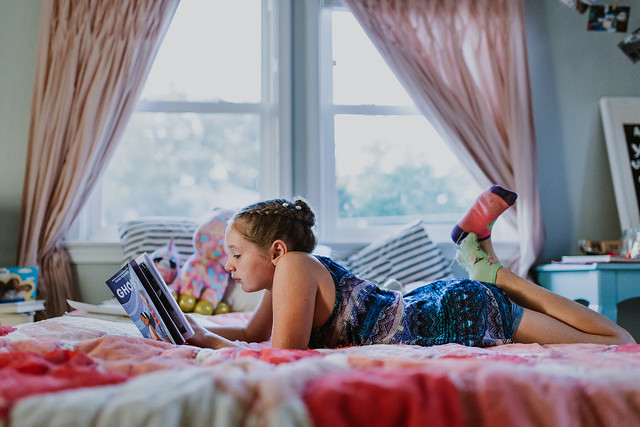
As you've probably noticed, we spent a lot of time in the car this summer. Without internet. Luckily, we had kindles. Here are P's reviews of some of her favorite reads:
________________________
Ms. Peregrine's Home for Peculiar Children is full of wonders - both creepy and great, with lots of imagination and suspense.
As a young boy the main character finds a collection of odd photographs. And when he is 15, he sees a monster after witnessing his grandpa's bloody death and every one thinks he is crazy. The thing is - was he? He always knew his grandfather was different, but how different? Then he found out something that blew his mind - it started out like a dream and became a nightmare. A remote island, odd children, and monsters - find it all in Ms. Peregrine's Home for Peculiar Children.
__________________________
The War That Saved My Life is a great book that will leave you on the edge of your seat.
This book takes place during World War II. The main character is a girl named Ada who is abused and hit by her mom because of her club foot. She soon finds out that all the children are being sent away in case the city gets bombed. But her mom will only let her brother go, not her. So even though Ada can't even walk, she sets out with her brother. When she arrives in the countryside things being to change for Ada - she learns new things, makes friends, rides a horse, and even stays with a nice person. But there are problems she didn't know about too. Read about Ada's journey in the War That Saved My Life.
___________________
Brown Girl Dreaming is a award winning book with a series of poems and chapters about a little girl and her life.
The book begins when the girl was little and she lived with here grand parents in the south. It describes her experiences there - how she loved everyone and everything was perfect. So it was hard for her when she moved to New York. It is a wonderful story about a girl, her 3 siblings, and her life, including the Civil Rights movement.
Labels:
Books for Kids,
Things to Read
9/1/16
Things to Read/Make/Do - Banish Boredom - Activities To Do With Kids That You'll Actually Enjoy
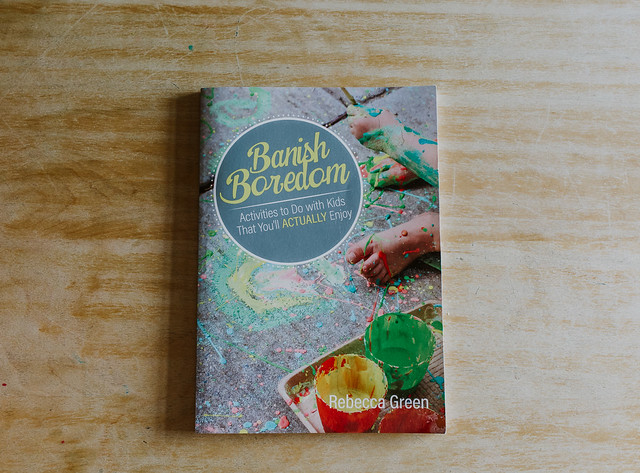
I have exciting news to share today - my friend Rebecca, from Not-So-SAHM, published a book and it's crazy awesome - full of fun things to do with your kids - from art and science projects to museums and field trips.
I've always loved Rebecca's blog and seeing her parenting philosophy captured in a book has made for a great read. In particular, I enjoyed reading about Rebecca's "personal approach to activities." As Rebecca explains, when looking for things to do with her children, she's had the best success "starting with [herself].
"Ask yourself what things do you want to do explore or learn more about? Pick one and start there. And then watch as your children react to activities involving that interest. I'm going to guess that as a parent of young kids, you're thinking something along the lines of:'Coffee. Coffee is something I can get into.' If so, find a local roaster and take the kids for a field trip! Maybe they'll be enamored by machinery, maybe they'll enjoy the smell, or maybe you'll come up with an art project out of coffee grounds. Or maybe you'll just get an amazing cup of coffee out of it."
That paragraph is probably the best parenting advice I've ever heard.
But the book also has so so much more - bouncy eggs, play dough, cloud classifiers, fake snow, frozen shaving cream (who knew you could freeze shaving cream?), etc. The kids and I can't wait to try several of these projects ourselves. I was planning to include photos of our own experiences with shaving cream in this post. But, it's the end of summer vacation, and I'm losing steam. So you'll have to wait a few more weeks.
In the meantime, Rebecca's book is available on Amazon, click here to pick up a copy! The activities are all open ended, so they should work with kids of all ages, but I think parents of children aged 4-7 would find the book especially helpful!
Labels:
art books,
Banish Boredom,
Things to Read
7/14/16
Things to Read - 10 Books I Want to Read This Summer
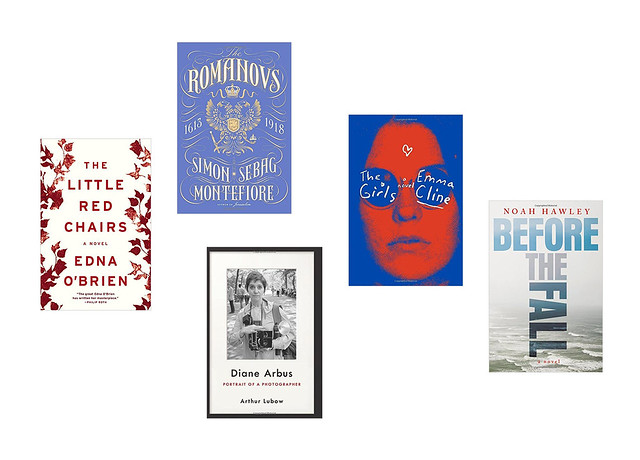
1. The Romanovs: 1613 - 1918 - On the way back from NYC, I listened to an interview with the author on NPR and was immediately entranced. According to Antony Beevor's review, this is "[a] story of conspiracy, drunken coups, assassination, torture, impaling, breaking on the wheel, lethal floggings with the knout, sexual and alcoholic excess, charlatans and pretenders, flamboyant wealth based on a grinding serfdom, and, not surprisingly, a vicious cycle of repression and revolt. Game of Thrones seems like the proverbial vicar's tea party in comparison."
2. The Girls - The New Yorker gave The Girls, Emma Cline's first novel, a huge write up. The book takes place in Northern California at the end of the 1960s and centers on a teenage girl's obsession with a Charles-Manson-like cult.
Apparently the characters, at times, seem a little removed (according to the review, "Cline has a habit of reaching for glamorous phrases, even if the glamour blinds the meaning. When she writes that 'the air was candied with silence' or that Evie’s father’s breath was 'notched with liquor,' she evokes little, except an anxiety to be stylish), but the writing is amazing.
3. Diane Arbus: Portrait of a Photographer - I always have mixed feelings about Arbus's amazing, but oh so creepy photographs. I think I prefer happier things (or, I believe, that life really is mostly happy). But this biography sounds fascinating.
For example, Arbus "once said that she had sex with any man who asked for it, and described a pool party at which she worked through the various men, one after the next, as if they were canapés." According to the New Yorke article, "[w]hat’s remarkable is that such liberty extended to her pictures. An orgy counted as work and leisure alike. Look at a contact sheet of young lovers, a black man and a white woman, from 1966, and you notice that the naked figure sprawled across him, in frame five, is Arbus."
4. The Little Red Chairs - Edna O'Brien has been written a lot of great books, but several critics are calling this her masterpiece. The novel centers on a small Irish town learning that a notorious war criminal and mass murderer is living among them.
5. Before the Fall - I learned about Before the Fall through the Book of the Month website. Judge Liberty Hardy summarizes the plot:"[o]n a foggy summer night, a small private plane departs Martha's Vineyard bound for New York City. Sixteen minutes later, the plane is in the ocean. Nine lives are lost. The only survivors are a four-year-old boy, now the sole heir to a huge fortune, and a down-on-his luck painter named Scott. Immediately, there are questions: What caused the crash? How did a poor artist end up on the private plane of a wealthy media mogul? Does he know what caused the crash? Did he cause the crash?"
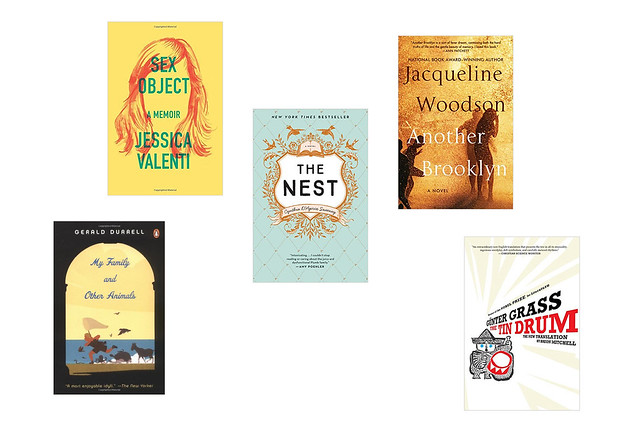
6. Another Brooklyn - Jacqueline Woodson is one of F's favorite young adult authors, so when I learned she recently wrote an adult novel about childhood friendships, I knew I had to read it.
7. The Nest - Another Book of the Month club recommendation the Book of the Month website. Judge Ellie Kemper describes the Nest as a book that "does not meander gently through the paths of four troubled siblings and their various problems; it flies." Kemper goes on to rave, "I apologize for the bird pun in the very first sentence of this review, but what can I say? I'm giddy. I could not put this book down. The Plumb family is a messed-up, dysfunctional, self-obsessed unit full of messed-up dysfunctional, self-obsessed members – much like your family or mine. What makes their journey a delight to read is the way that Cynthia D'Aprix Sweeney seamlessly and artfully weaves their stories together."
8. My Family & Other Animals - I learned about this memoir through Miss Moss, as the story was recently adapted as a TV show (doesn't it look awesome)? The book tells the story of a family who moves from Britain to Corfu, Greece in the 1930s. And nothing says summer like a book about Greek island life.
9. Sex Object, A Memoir - I'm on a feminist reading kick lately, so this seems right up my alley. "A memoir that Publishers Weekly calls “bold and unflinching,” Valenti explores the toll that sexism takes on women’s lives, from the everyday to the existential. From subway gropings and imposter syndrome to sexual awakenings and motherhood, Sex Object reveals the painful, embarrassing, and sometimes illegal moments that shaped Valenti’s adolescence and young adulthood in New York City."
10. The Tin Drum - Because this is the classic novel that Gunter Grass basically won a Nobel Prize for and I haven't read it.
6/30/16
Things to Read - Feminist Fiction (for Adults)
Ever since I finished Elena Ferrante's Neapolitan series (which I reviewed here), I've felt like I just lost a good friend. I miss the main characters, I had hoped to grow old with them.
So in a quest to "relive" Ferrante's magic, I've been reading feminist fiction like crazy.
What is feminist fiction?
Honestly, I have no idea. But if you google enough, certain titles start to reappear.
Why feminist fiction?
Basically, I wanted to read novels about women. And I didn't want them to be funny or silly or to make fun of themselves. As much as I love (and I do love) Bridget Jone's Diary, I hoped to spend a few weeks discovering stories about female friendships and female thoughts and female problems and I did not want any of it dumbed down. I wanted REAL.
Here's what I found:


1. The Women's Room - This book, published in 1977, was a huge bestseller at the time. Forty years later some of the main character's problems seem dated. Does anyone feel the need to marry right out of high school anymore? Nevertheless many of the characters' problems are disturbingly current - for example, the rape scene in which they blame the girl sounds shockingly familiar in today's world, as does the endless need to balance children and a career.
What I liked best - The author's descriptions of women's friendships.
What I liked least - Some parts drag. In an effort to tell the story of several different women, the book often loses focus and tends to meander.
____________________________


2. The Country Girls Trilogy - This novel centers on two Irish girls in the 1950s. And if The Women's Room made things seem bad, the girls in this book are often little more than chattel. You just keep waiting for someone to love them as much as you do or, at the least, to acknowledge them as human beings. It's a tough read.
As summarized on Wikipedia, "O'Brien's works often revolve around the inner feelings of women, and their problems in relating to men, and to society as a whole.[3] Her first novel, The Country Girls, is often credited with breaking silence on sexual matters and social issues during a repressive period in Ireland following World War II.[4] The book was banned, burned and denounced from the pulpit, and O'Brien left Ireland behind."
What I liked best - The writing is stellar. And, yet again, the portrait of this complicated friendship is wonderful to read.
What I liked least - It's a sad book. Perhaps too sad.
_________________________


3. Beloved - I can't believe I turned 40 without reading this classic about a former slave haunted by her baby's ghost.
What I liked best - Morrison's wording and descriptions are like nothing I've ever read. Words seem to dance off the page. No wonder she won the Nobel Prize.
What I liked least - Certain sections are slow. The beginning is confusing (REALLY confusing), though if you keep reading, it all comes together.
_______________________


4. The Golden Notebook - Every feminist reading list includes this book. It's like THE BOOK. Which makes sense as Lessing won the Nobel Prize. The novel's storyline revolves around Anna, the main character's, four notebooks. "In one, with a black cover, [Anna] reviews the African experience of her earlier years. In a red one she records her political life, her disillusionment with communism. In a yellow one she writes a novel in which the heroine relives part of her own experience. And in a blue one she keeps a personal diary. Finally, in love with an American writer and threatened with insanity, Anna resolves to bring the threads of all four books together in a golden notebook."
What I liked best - The main character's struggle to live independently in a world where such independence is constantly judged.
What I liked least - The final 100 pages are just boring. Lessing describes (in detail) a tumultuous relationship, but reading about this relationship makes you hate both the participants, you just want out.
_____________________________


5. The Fifth Child - Once I read one Doris Lessing book, I had to read another. The Fifth Child is COMPLETELy different from the Golden Notebook. For starters, it's a much easier read (lots of suspense). Further, the main characters of both novels have almost nothing in common.
The Fifth Child tells the story of a couple who wants to have a large family. Despite some ups and downs, everything goes pretty well until the fifth child is born. He's not quite Rosemary's Baby, but he's close.
How do you mother a child whose every instinct involves inflicting pain on others? And how do you protect your other children from such a creature. In a world where parents are blamed for every little thing they do wrong, this book is a MUST READ. After reading it, you can't stop thinking - but what is right? what would I do?
What I liked best - This book will be with me forever. The moral quandary presented haunts me at night.
What I liked least - There's a certain coldness to the book. As if you feel more empathy for the mother than the author does. I'm still not sure how I feel about this as a writing technique.
So in a quest to "relive" Ferrante's magic, I've been reading feminist fiction like crazy.
What is feminist fiction?
Honestly, I have no idea. But if you google enough, certain titles start to reappear.
Why feminist fiction?
Basically, I wanted to read novels about women. And I didn't want them to be funny or silly or to make fun of themselves. As much as I love (and I do love) Bridget Jone's Diary, I hoped to spend a few weeks discovering stories about female friendships and female thoughts and female problems and I did not want any of it dumbed down. I wanted REAL.
Here's what I found:


1. The Women's Room - This book, published in 1977, was a huge bestseller at the time. Forty years later some of the main character's problems seem dated. Does anyone feel the need to marry right out of high school anymore? Nevertheless many of the characters' problems are disturbingly current - for example, the rape scene in which they blame the girl sounds shockingly familiar in today's world, as does the endless need to balance children and a career.
What I liked best - The author's descriptions of women's friendships.
What I liked least - Some parts drag. In an effort to tell the story of several different women, the book often loses focus and tends to meander.
____________________________


2. The Country Girls Trilogy - This novel centers on two Irish girls in the 1950s. And if The Women's Room made things seem bad, the girls in this book are often little more than chattel. You just keep waiting for someone to love them as much as you do or, at the least, to acknowledge them as human beings. It's a tough read.
As summarized on Wikipedia, "O'Brien's works often revolve around the inner feelings of women, and their problems in relating to men, and to society as a whole.[3] Her first novel, The Country Girls, is often credited with breaking silence on sexual matters and social issues during a repressive period in Ireland following World War II.[4] The book was banned, burned and denounced from the pulpit, and O'Brien left Ireland behind."
What I liked best - The writing is stellar. And, yet again, the portrait of this complicated friendship is wonderful to read.
What I liked least - It's a sad book. Perhaps too sad.
_________________________


3. Beloved - I can't believe I turned 40 without reading this classic about a former slave haunted by her baby's ghost.
What I liked best - Morrison's wording and descriptions are like nothing I've ever read. Words seem to dance off the page. No wonder she won the Nobel Prize.
What I liked least - Certain sections are slow. The beginning is confusing (REALLY confusing), though if you keep reading, it all comes together.
_______________________


4. The Golden Notebook - Every feminist reading list includes this book. It's like THE BOOK. Which makes sense as Lessing won the Nobel Prize. The novel's storyline revolves around Anna, the main character's, four notebooks. "In one, with a black cover, [Anna] reviews the African experience of her earlier years. In a red one she records her political life, her disillusionment with communism. In a yellow one she writes a novel in which the heroine relives part of her own experience. And in a blue one she keeps a personal diary. Finally, in love with an American writer and threatened with insanity, Anna resolves to bring the threads of all four books together in a golden notebook."
What I liked best - The main character's struggle to live independently in a world where such independence is constantly judged.
What I liked least - The final 100 pages are just boring. Lessing describes (in detail) a tumultuous relationship, but reading about this relationship makes you hate both the participants, you just want out.
_____________________________


5. The Fifth Child - Once I read one Doris Lessing book, I had to read another. The Fifth Child is COMPLETELy different from the Golden Notebook. For starters, it's a much easier read (lots of suspense). Further, the main characters of both novels have almost nothing in common.
The Fifth Child tells the story of a couple who wants to have a large family. Despite some ups and downs, everything goes pretty well until the fifth child is born. He's not quite Rosemary's Baby, but he's close.
How do you mother a child whose every instinct involves inflicting pain on others? And how do you protect your other children from such a creature. In a world where parents are blamed for every little thing they do wrong, this book is a MUST READ. After reading it, you can't stop thinking - but what is right? what would I do?
What I liked best - This book will be with me forever. The moral quandary presented haunts me at night.
What I liked least - There's a certain coldness to the book. As if you feel more empathy for the mother than the author does. I'm still not sure how I feel about this as a writing technique.
6/9/16
Things to Read - Humans of New York, Stories
Do you follow Brandon Stanton's blog Humans of New York? If not you're really missing out (though beware - it often makes one cry).
Anyways, I LOVE LOVE LOVE this new anthology. So many different perspectives and quotes. Even Dan could't stop reading. It's just so good. I've quoted a sampling below, but you really have to read the whole book to appreciate the scope.
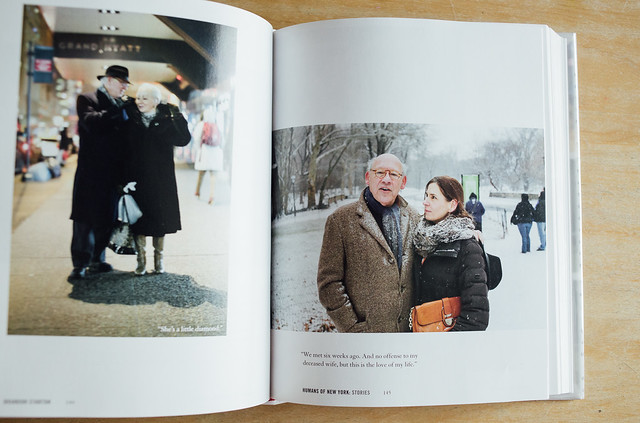
"We met six weeks ago. And no offense to my deceased wife, but this is the love of my life."
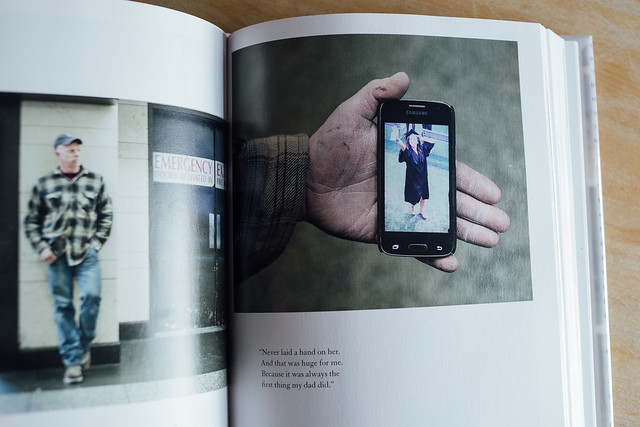
"Never laid a hand on her. And that was huge for me. Because it was always the first thing my dad did."
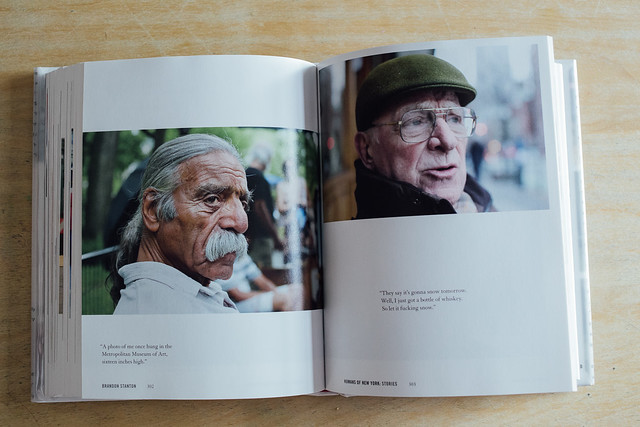
"They say it's gonna snow tomorrow. Well I just got a bottle of whiskey. So let it fucking snow."
"A photo of me once hung in the Metropolitan Museum of Art, sixteen inches high."
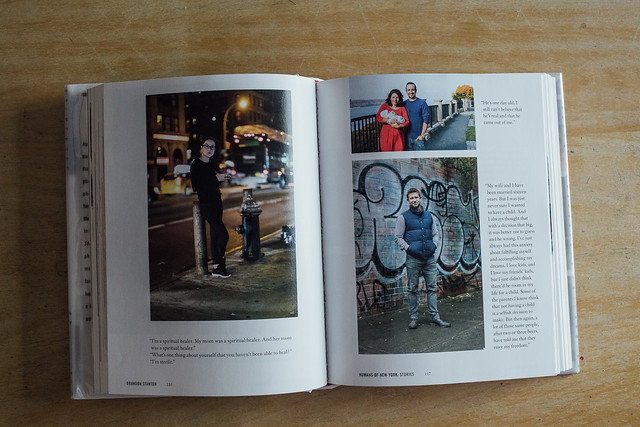
"He's one day old. I still can't believe that he's real and that he came out of me."
Labels:
Humans of New York,
Things to Read
6/2/16
Things to Read (for Kids) - Marvel's Squirrel Girl
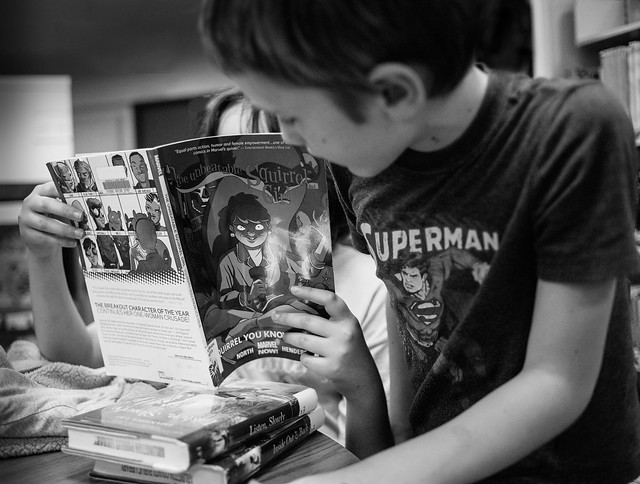
Lately the girls (especially P) have read a lot of Marvel comic books. While they love the action, the girls both complain that the female superheroes are somewhat lacking. Or as P phrased it, "all Marvel comics are a little bit sexist."
So I was pretty excited after I read a Washington Post article on Marvel's newest creation - Squirrel Girl (yes, go ahead and laugh, but don't forget that Antman was one of last summer's biggest blockbusters).
So what makes Squirrel Girl different from other superheros? “Her first instinct is to beat someone up but she always ends up making friends with them. It’s: ‘Maybe we can talk. Can I help?’ She looks for empathy and compromise more than solving problems with her fists. This is kind of revolutionary in superhero comics. Look at Batman and Superman, punching each other all the time for no good reason. Squirrel Girl is inclined to have a conversation first.”
Further, unlike most female superheros, squirrel girl doesn't look like a supermodel or a Barbie doll. How cool is that?
So what did F and P think of "The Unbeatable Squirrel Girl Vol. 1: Squirrel Power"? It's complicated:
P - I like that she's a girl and that the story is good, but I find it annoying that she's both a girl and the only superhero who always tries to work out problems, while all the boys have battles and use their superpowers.
F - But that's what makes Squirrel Girl so cool, she doesn't care about fighting, she gets people to work together. To be better.
P - I know and I get that. But why is it always girls that have to make people work together? Why can't boys do that too? I'm sick of everyone saying how great girls are but then acting like all girls are capable of is being nice and making other people nice.
F - But that's what is so awesome about girls.
P - But that should be what's so awesome about everybody. if the girls are going to be nice so should the boys. I'd like to read a comic about a boy who solves problems without fighting and in the same book I'd like a girl who can fight. And win.
At this point I broke in to explain that this 3rd grade/4th grade debate summarizes a lot of key problems/issues for feminism (or at least in my mind it does). And that I have no answers.
But I'm so f**ing glad we're having the conversation. So kudos to Squirrel Girl, keep "kick[ing] butts and eat[ing] nuts." Hopefully a Squirrel Boy will join you soon.
[Random note - The photo above was totally unposed (though I was trying to take a photo of F reading Squirrel Girl), only when I downloaded it did I realize how crazy appropriate T's fighting superhero shirt was for this post. As I always say, "the best moments are the real moments".
Labels:
comics,
marvel,
squirrel girl,
Things to Read
5/5/16
Things to Read - Six Interesting Articles From Around the Web (on Sex and the City, Writing Like a Man, Headscarfs, Angry White Females, Nannies, and Botox)
I haven't posted articles in a long time, mainly because I read very little nonfiction over the winter. But now that the weather is warmer I can return to reading the New Yorker while walking the dogs (random hobby). So here goes, I've been on a feminist kick lately:
__________________________
(1) Sex and the City - The New Yorker has a great article on "How Sex and the City Lost its Good Name." Do you still like the show or do you find it dated?
"Carrie and her friends—Miranda, Samantha, and Charlotte—were odder birds by far, jagged, aggressive, and sometimes frightening figures, like a makeup mirror lit up in neon. They were simultaneously real and abstract, emotionally complex and philosophically stylized. Women identified with them—“I’m a Carrie!”—but then became furious when they showed flaws. And, with the exception of Charlotte (Kristin Davis), men didn’t find them likable: there were endless cruel jokes about Samantha (Kim Cattrall), Miranda (Cynthia Nixon), and Carrie as sluts, man-haters, or gold-diggers. To me, as a single woman, it felt like a definite sign of progress: since the elemental representation of single life at the time was the comic strip “Cathy” (ack! chocolate!), better that one’s life should be viewed as glamorously threatening than as sad and lonely."
. . . .
"So why is the show so often portrayed as a set of empty, static cartoons, an embarrassment to womankind? It’s a classic misunderstanding, I think, stemming from an unexamined hierarchy: the assumption that anything stylized (or formulaic, or pleasurable, or funny, or feminine, or explicit about sex rather than about violence, or made collaboratively) must be inferior."
_____________________
(2) Writing Like a Man - Claire Vaye Watkins' article "On Pandering" may be the best piece of nonfiction I've ever read.
"The stunning truth is that I am asking, deep down, as I write, What would Philip Roth think of this? What would Jonathan Franzen think of this? When the answer is probably: nothing. More staggering is the question of why I am trying to prove myself to writers whose work, in many cases, I don’t particularly admire? I recently finished Roth’s Indignation with nothing more lasting than a sincere curiosity as to whether Roth is aware that these days even nice girls give blow jobs.
I am trying to understand a phenomenon that happens in my head, and maybe in yours too, whereby the white supremacist patriarchy determines what I write.
I wrote Battleborn for white men, toward them. If you hold the book to a certain light, you’ll see it as an exercise in self-hazing, a product of working-class madness, the female strain. So, natural then that Battleborn was well-received by the white male lit establishment: it was written for them. The whole book’s a pander. Look, I said with my stories: I can write old men, I can write sex, I can write abortion. I can write hard, unflinching, unsentimental. I can write an old man getting a boner!
Here are the lampposts, here is the single-screen movie theater. It’s all an architecture of pandering. It’s for them.
She can write like a man, they said, by which they meant, She can write."
_____________________
(3) Headscarfs - I'm still trying to figure out how I feel about Elif Batuman's essay on her personal conflicts with wearing a headscarf while traveling in Turkey.
"I wondered why it hadn’t occurred to me sooner to try wearing a head scarf—why nobody ever told me it was something I could do. It wasn’t difficult, or expensive. Why should I not cover my head here, if it made the people who lived here feel so much better? Why should I cause needless discomfort to them and to myself? Out of principle? What principle? The principle that women were equal to men? To whom was I communicating that principle? With what degree of success? What if I thought I was communicating one thing but what people understood was something else—what if what they understood was that I disapproved of them and thought their way of life was backward? Did that still count as “communicating”?
I found myself thinking about high heels. High heels were painful, and, for me at least, expensive, because they made walking more difficult and I ended up taking more taxis. Yet there were many times when I wore heels to work-related events in New York, specifically because I felt it made people treat me with more consideration. Why, then, would I refuse to wear a head scarf, which brought a similar benefit of social acceptance, without the disadvantage of impeding my ability to stand or walk?
And yet, when I thought about leaving the scarf on for the rest of my stay, something about it felt dishonest, almost shameful, as if I were duping people into being kind to me. Those girls who smiled into my eyes—they thought I was like them. The guy who helped me on the bus—he thought I was his sister."
_______________________
(4) Angry White Females - I loved the LA Times article "Angry while female: Why it matters that Beyonce, Kelly Ripa and Samantha Bee won't hide their outrage."
"For women, though, it’s a bit trickier, as all those “angry feminists” can attest. As clashing reactions to Ripa and far too many studies reveal, women are still often penalized for getting angry, even when anger is the appropriate reaction to the situation.
During the recent #Oscarssowhite controversy, for example, both Spike Lee and Jada Pinkett Smith announced they would not be attending the ceremony. But it was Pinkett Smith who became, and remained, the butt of angry jokes, many of which boiled down to “..., who said you were even invited?”
The b-word, of course, is cited in study after study about the different perceptions of male and female anger: Where men are considered “firm,” women are seen as “controlling” and worse.
As Ripa discovered, women who react when provoked are still often accused of seeming “crazy” (which, with its evocations of a time when women could be committed to an asylum for rebelling against their husbands or fathers, is in itself a provocation).
“Jealous or crazy,” Beyoncé sings over and over again in “Lemonade’s” “Hold Up,” blurring the words synonymous before deciding: “More like being walked all over lately, walked all over lately / I’d rather be crazy.”
Some of it is a simple question of volume: Men shout in righteous rage, but women who raise their voices are still often seen as losing control or, heaven forbid, “shrill.”
_______________________
(5) Nannies - In "the Cost of Caring", Rachel Aviv (somewhat heartbreakingly) profiles Filipino caregivers in America.
"During meals in Chappaqua, Emma sometimes felt guilty and lost her appetite. “If you are a mom, you want anything you eat to be shared by your kids,” she said. Sometimes, as she dressed the girls in the morning, she cried as she imagined her youngest children preparing for school with the assistance of the helpers. One of the helpers had a young son. Emma asked her children who cared for the boy while his mother was at their house, but her daughters didn’t know. Emma imagined a chain of mothers parenting other mothers’ children around the globe."
. . . .
"Timing one’s departure from America is a precarious art. Emma, Ivy, and their friends speak of their return to the Philippines as a kind of afterlife, an endless family celebration, where they will finally reap the rewards of their sacrifice. The window for return begins once they’ve put their children through school—often their grandchildren, too—but then the calculation becomes more complex. Should they stay longer, save for retirement, and risk growing ill in America? Or leave prematurely, run out of money, and be poor again in the Philippines?
Recently, one of Emma’s friends tragically mistimed her return. She was given a diagnosis of ovarian cancer in December and, less than two months later, died without having seen her husband or her children in years. Emma and her friends raised money for “death aid.” They wanted to help the woman’s husband, who ran a poultry farm that Emma used to visit, pay for his wife’s body to be shipped home. The day after the body was flown overseas, I accompanied Emma to her nannying job on the Upper East Side, where she was struggling to put the memory out of her mind. When she viewed the body, three days earlier, she was shocked by how thin her friend had become. “What kind of life is this?” Emma said."
________________________
(6) Botox - And finally, Amanda Peet's anti-Botox essay went viral this week (I feel that I should disclaim that I'm personally a Botox fan, but I still found the essay a great read).
"Another frightening scenario is that one or both of my daughters will do as I did in my youth: go to college, take Feminist Texts and Theory, and stop shaving their legs and armpits. As hard-core feminists, they'll write me off. I'll cry, Why aren't you coming home for Thanksgiving? And they'll be like, You're nothing but a foot soldier for the beauty industrial complex. Letting my face age naturally will be my ace in the hole. My counterclaim. Proof that I didn't pander to the male gaze.
. . . .
our cultural obsession with beauty and self-improvement is compounded by the fact that we're living in the Age of Digital Narcissism; and how, because of this phenomenon, girls as young as nine — the age of her [my sister's] daughter and my eldest — show a "disturbing level of anxiety" about their looks."
__________________________
(1) Sex and the City - The New Yorker has a great article on "How Sex and the City Lost its Good Name." Do you still like the show or do you find it dated?
"Carrie and her friends—Miranda, Samantha, and Charlotte—were odder birds by far, jagged, aggressive, and sometimes frightening figures, like a makeup mirror lit up in neon. They were simultaneously real and abstract, emotionally complex and philosophically stylized. Women identified with them—“I’m a Carrie!”—but then became furious when they showed flaws. And, with the exception of Charlotte (Kristin Davis), men didn’t find them likable: there were endless cruel jokes about Samantha (Kim Cattrall), Miranda (Cynthia Nixon), and Carrie as sluts, man-haters, or gold-diggers. To me, as a single woman, it felt like a definite sign of progress: since the elemental representation of single life at the time was the comic strip “Cathy” (ack! chocolate!), better that one’s life should be viewed as glamorously threatening than as sad and lonely."
. . . .
"So why is the show so often portrayed as a set of empty, static cartoons, an embarrassment to womankind? It’s a classic misunderstanding, I think, stemming from an unexamined hierarchy: the assumption that anything stylized (or formulaic, or pleasurable, or funny, or feminine, or explicit about sex rather than about violence, or made collaboratively) must be inferior."
_____________________
(2) Writing Like a Man - Claire Vaye Watkins' article "On Pandering" may be the best piece of nonfiction I've ever read.
"The stunning truth is that I am asking, deep down, as I write, What would Philip Roth think of this? What would Jonathan Franzen think of this? When the answer is probably: nothing. More staggering is the question of why I am trying to prove myself to writers whose work, in many cases, I don’t particularly admire? I recently finished Roth’s Indignation with nothing more lasting than a sincere curiosity as to whether Roth is aware that these days even nice girls give blow jobs.
I am trying to understand a phenomenon that happens in my head, and maybe in yours too, whereby the white supremacist patriarchy determines what I write.
I wrote Battleborn for white men, toward them. If you hold the book to a certain light, you’ll see it as an exercise in self-hazing, a product of working-class madness, the female strain. So, natural then that Battleborn was well-received by the white male lit establishment: it was written for them. The whole book’s a pander. Look, I said with my stories: I can write old men, I can write sex, I can write abortion. I can write hard, unflinching, unsentimental. I can write an old man getting a boner!
Here are the lampposts, here is the single-screen movie theater. It’s all an architecture of pandering. It’s for them.
She can write like a man, they said, by which they meant, She can write."
_____________________
(3) Headscarfs - I'm still trying to figure out how I feel about Elif Batuman's essay on her personal conflicts with wearing a headscarf while traveling in Turkey.
"I wondered why it hadn’t occurred to me sooner to try wearing a head scarf—why nobody ever told me it was something I could do. It wasn’t difficult, or expensive. Why should I not cover my head here, if it made the people who lived here feel so much better? Why should I cause needless discomfort to them and to myself? Out of principle? What principle? The principle that women were equal to men? To whom was I communicating that principle? With what degree of success? What if I thought I was communicating one thing but what people understood was something else—what if what they understood was that I disapproved of them and thought their way of life was backward? Did that still count as “communicating”?
I found myself thinking about high heels. High heels were painful, and, for me at least, expensive, because they made walking more difficult and I ended up taking more taxis. Yet there were many times when I wore heels to work-related events in New York, specifically because I felt it made people treat me with more consideration. Why, then, would I refuse to wear a head scarf, which brought a similar benefit of social acceptance, without the disadvantage of impeding my ability to stand or walk?
And yet, when I thought about leaving the scarf on for the rest of my stay, something about it felt dishonest, almost shameful, as if I were duping people into being kind to me. Those girls who smiled into my eyes—they thought I was like them. The guy who helped me on the bus—he thought I was his sister."
_______________________
(4) Angry White Females - I loved the LA Times article "Angry while female: Why it matters that Beyonce, Kelly Ripa and Samantha Bee won't hide their outrage."
"For women, though, it’s a bit trickier, as all those “angry feminists” can attest. As clashing reactions to Ripa and far too many studies reveal, women are still often penalized for getting angry, even when anger is the appropriate reaction to the situation.
During the recent #Oscarssowhite controversy, for example, both Spike Lee and Jada Pinkett Smith announced they would not be attending the ceremony. But it was Pinkett Smith who became, and remained, the butt of angry jokes, many of which boiled down to “..., who said you were even invited?”
The b-word, of course, is cited in study after study about the different perceptions of male and female anger: Where men are considered “firm,” women are seen as “controlling” and worse.
As Ripa discovered, women who react when provoked are still often accused of seeming “crazy” (which, with its evocations of a time when women could be committed to an asylum for rebelling against their husbands or fathers, is in itself a provocation).
“Jealous or crazy,” Beyoncé sings over and over again in “Lemonade’s” “Hold Up,” blurring the words synonymous before deciding: “More like being walked all over lately, walked all over lately / I’d rather be crazy.”
Some of it is a simple question of volume: Men shout in righteous rage, but women who raise their voices are still often seen as losing control or, heaven forbid, “shrill.”
_______________________
(5) Nannies - In "the Cost of Caring", Rachel Aviv (somewhat heartbreakingly) profiles Filipino caregivers in America.
"During meals in Chappaqua, Emma sometimes felt guilty and lost her appetite. “If you are a mom, you want anything you eat to be shared by your kids,” she said. Sometimes, as she dressed the girls in the morning, she cried as she imagined her youngest children preparing for school with the assistance of the helpers. One of the helpers had a young son. Emma asked her children who cared for the boy while his mother was at their house, but her daughters didn’t know. Emma imagined a chain of mothers parenting other mothers’ children around the globe."
. . . .
"Timing one’s departure from America is a precarious art. Emma, Ivy, and their friends speak of their return to the Philippines as a kind of afterlife, an endless family celebration, where they will finally reap the rewards of their sacrifice. The window for return begins once they’ve put their children through school—often their grandchildren, too—but then the calculation becomes more complex. Should they stay longer, save for retirement, and risk growing ill in America? Or leave prematurely, run out of money, and be poor again in the Philippines?
Recently, one of Emma’s friends tragically mistimed her return. She was given a diagnosis of ovarian cancer in December and, less than two months later, died without having seen her husband or her children in years. Emma and her friends raised money for “death aid.” They wanted to help the woman’s husband, who ran a poultry farm that Emma used to visit, pay for his wife’s body to be shipped home. The day after the body was flown overseas, I accompanied Emma to her nannying job on the Upper East Side, where she was struggling to put the memory out of her mind. When she viewed the body, three days earlier, she was shocked by how thin her friend had become. “What kind of life is this?” Emma said."
________________________
(6) Botox - And finally, Amanda Peet's anti-Botox essay went viral this week (I feel that I should disclaim that I'm personally a Botox fan, but I still found the essay a great read).
"Another frightening scenario is that one or both of my daughters will do as I did in my youth: go to college, take Feminist Texts and Theory, and stop shaving their legs and armpits. As hard-core feminists, they'll write me off. I'll cry, Why aren't you coming home for Thanksgiving? And they'll be like, You're nothing but a foot soldier for the beauty industrial complex. Letting my face age naturally will be my ace in the hole. My counterclaim. Proof that I didn't pander to the male gaze.
. . . .
our cultural obsession with beauty and self-improvement is compounded by the fact that we're living in the Age of Digital Narcissism; and how, because of this phenomenon, girls as young as nine — the age of her [my sister's] daughter and my eldest — show a "disturbing level of anxiety" about their looks."
Labels:
Interesting Articles,
Things to Read
4/7/16
Things to Read/Make/Eat - The Wilderness Ranger Cookbook
Every spring my goal is camp more often. But then summer comes, bringing pools and heat and lazy, and I lose momentum. Oh well, since it's only April, I'm still dreaming of days spent in the wilderness with family and friends.
One of the problems with camping is I never know quite what to cook, as one can only eat so many hot dogs and smores. So I'm pretty excited about my random library discovery of the Wilderness Ranger Cookbook, which has tons of fun/quirky/creative concoctions.

3/17/16
Things to Read - Book Reviews from a 4th Grader
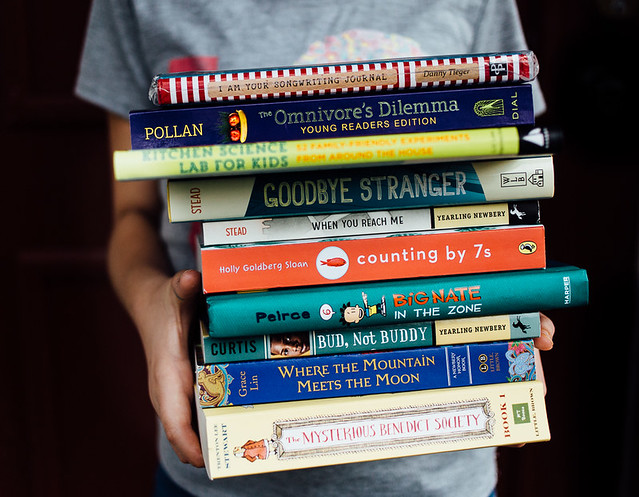
For F's birthday (yes, WAY back in October) she saved up a ton of gift cards for a Barnes & Noble shopping spree.
For the last five months, I've asked her to review the books she read, but sometimes it takes awhile to get a post together. So we've been gradually working on this over the winter. Luckily, finally, I have some great book recommendations from my fabulous 10 year old! Just in time for spring!
F's book reviews:
1. The Mysterious Benedict Society - Like many books full of wonderful adventures and incredible tales, this book started off a little boring. But after the first chapter, I could not put it down. It is a story of several kids, all orphans, who have just joined a mysterious society, and they must go undercover in order to stop the evil villain who is terrorizing the world without the victims even knowing it. With many twists and turns and ups and downs, this book will want to make you laugh, cry, and maybe even do a little sneaking around yourself. Four and one half stars, kids 8-13.
2. Where the Mountain Meets the Moon - Unfortunately, this tale has not yet been explored. Come again for a review!
3. Bud Not Buddy - This award-winning book gets straight to the point, no patience required. (Which is good, if you are like me.) Bud, Not Buddy tells the wonderful, realistic story of a boy named Bud who has lost his mother and has no idea where his dad is. Taking place during the civil rights movement of the 1960's, Bud is looking for his Dad with some clues his mom has left behind, which takes him to all sorts of exciting and new places. If you liked this, there is also a book about one of the friends Bud meets on the way home: Malone. The follow-up is called "The Mighty Miss Malone", and although I have not read it myself, I want to soon. With a wonderful tale and many adventures, the only thing I would change is the ending, which I thought could have been a bit more satisfying, but does not make a dent in this book's awesomeness. Four stars, kids 9-15.
4. Big Nate in the Zone - Okay, all you adults, I know Big Nate does not qualify as "real literature", but this book just can NOT be beat. Big Nate, the eternal sixth-grader, is my all-time FAVORITE comic. All the books are so funny, and they make me laugh a little every time. This book is no different. With a single lucky action-figure plastic foot, he turns his life around. But how long will it last? For kids of all ages, this five-star book is "in the zone"!
5. Counting by 7s - This book follows the adventures of Willow, who is an only adopted child and loves plants. But when her parents both die and she has no other family members to go to, she ends up living with someone she just met. With the help of the friendly girl Willow has recently come across, that friend's mother, a lazy school counselor, and a taxi cab driver who is turning his life around, Willow finds home in places she never thought she would. It is an incredible story, four and one half stars out of five. This book will make you feel sorry for Willow, thankful for her Mother, and annoyed at the World's Worst Counselor. For kids 8-13.
6. When You Reach Me - This book reminded me of A Wrinkle in Time. They are both Newbery Medal winning books, and they both have time travel as a big part of the story. The main character lives with her mom in a low-class apartment building in New York City. She is currently having troubles with her best friend, and she is worrying he does not like her anymore. Meanwhile, her mom has just been selected for a TV show where she could either win big and take home 20,000 dollars or come back with nothing. The main character is struggling to fit in without her best friend beside her, and the mysterious laughing man who lives under the mailbox on the corner just gets weirder every day. Four stars, kids 10-15.
7. Goodbye Stranger - Goodbye Stranger is an incredible book. It explores the excitement of growing up, and how bullying comes in different forms, and for different reasons. With shifting points of view, it all comes together. As wonderful as this book is, I would not recommend it for children under the age of nine. I don't remember all of it, but I do remember the feminist, the girl who almost died, and Emily, the soccer player who is going through puberty. There is also an unnamed high-school girl who struggles with a betrayal, who the author finally reveals at the end of the story. For ages 9-19, this book will take you an an eye-opening, tear jerking, and very entertaining roller-coaster ride. 5 out of 5 stars!!!!!
8. Kitchen Science Lab for Kids - I have not explored this book yet.
9. Omnivore's Dilemma: Young Reader's Edition - Also has not been read. [Note from Darcy - I bought this for F and offered her a $10 bribe to read it, but it's still on the bookshelf. Maybe one day?]
10. I Am Your Songwriting Journal - It is a journal that helps you write songs. Need I say more?
Labels:
book reviews,
F book reviews,
kids books,
Things to Read
Subscribe to:
Posts (Atom)
LinkWithin
