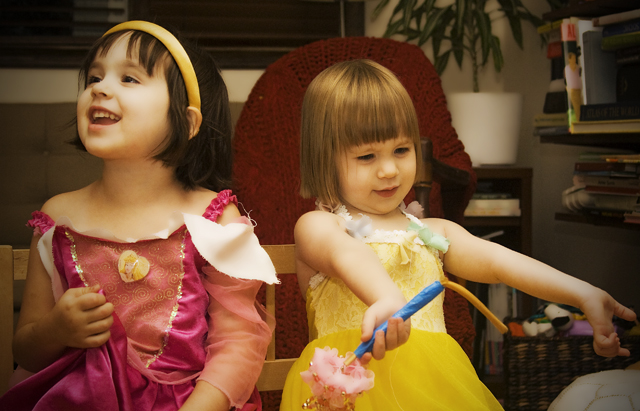
Lots of parents of girls come into this experience prepared for battle. I was not one of those moms. In fact, it took me years to realize a problem existed. When F asked for a princess dress, I bought her a princess dress - then two, then four, then who knows how many. When she asked to wear the dresses everywhere, I let her wear them, despite condescending conversations parents who proclaimed "my daughter is NOT a princess girl," which I translated as meaning, "I'm not a princess mom/dad." My goal as a parent has always been to teach my children that they can be anything they want to be (as cheesy as that sounds). So if F, at the age of 3, wanted to make feudalistic fashion choices, I let it be.
The real problem manifested itself during a bbque with family friends. F was 3, as was E, our friends' son. When I looked over F was sitting by herself on the patio, E was coming my way. "She says she's in the tower and needs me to get her out." "Seriously?" I asked. But this was just beginning, throughout the morning F refused all of E's efforts. He didn't slay the dragon severely enough. He didn't run fast enough. The key was the wrong size. After an hour, my daughter still resided in an imaginary fortress and E had had enough. So had I. How did this happen? How had my "you can be anything you want to be" parenting resulted in my daughter forcing boys to rescue her? Proactive measures were needed.
After the bbque, a friend recommended Sharon Lamb and Lyn Mikel Brown's Packaging Girlhood: Rescuing Our Daughters from Marketers' Schemes
 and I practically inhaled it. In retrospect, I think the book's analysis is a little over aggressive - as in yes, I agree a problem exists, but unlike the book's authors I don't think the sky is caving in, so to speak. Yet the book contains several interesting questions and discussion topics to broach with children (boys or girls), such as "[i]sn't it funny that just because there are boys and girls, everyone seems to think they're opposite?" and "Why do you think they chose a girl who is so pretty an skinny to play the role? Why do you think they decided to have the prince rescue the princess three times? Why do you think they decided to make the sidekick or the creatures that accompany her all boys?" Along with such questions the book does a good job emphasizing that it is up to us, as parents, to not let our children fall into marketing traps, "adolescent girls may believe that what they are expressing [when they buy into marketing] is uniquely them, but it's your job to mirror back to them what is really unique and interesting about them."
 Each chapter of Packaging Girlhood analyzes a different type of marketing to girls - fashion, tv/movies, music, books, and hobbies. I found the chapter on what girls read particularly inciteful/scary. I have a tendency as a parent to always view reading as a good thing, but the book makes a convincing argument that often books geared primarily to girls emphasize the very stereotypes one hopes to avoid (i.e. "math is hard", "all i want is to be pretty", etc.). Scary.
In our own family, the issue of stereotypes in "girls'" books arose recently when my mom sent the girls a care package containing a Barbie-learn-to-read book. As F looked through the book's illustrations she asked me, "mom, why are all the girls just sitting by the pool watching the boys swim? Why aren't they swimming too?" For a moment part of me felt incredibly sad that after years of feminism and "women can be whoever they want to be" I had to explain to my daughter that, yes, teenage girls are allowed in the pool. But then I became grateful that F raised the issue, that she now picks up stereotypes better than I do.
Another great read on the topic of girls and marketing is Peggy Orenstein's Cinderella Ate My Daughter: Dispatches from the Front Lines of the New Girlie-Girl Culture
 . Orenstein writes in a funny, conversational tone, while digging into the issue of "[w]hy has girlhood become so monochromatic?" As summarized by Orenstein, "[l]ittle girls may have more real-life role models than they used to, more examples of how to be in the world, but they have precious few larger-than-life heroes, especially in the all-important realm of fantasy, where they spend so much of their free time." I highly suggest reading it.
 Of course, the problem doesn't reside in marketing alone. I think as parents it becomes so easy to focus on all the differences between girls and boys, but you have to realize that kids hear what you're saying. And the message can be quite strong. For example, "oh, of course your girl loves princesses that's so cute, my son is SUCH A BOY - he only loves superheros and saving the world." Translation to a child - girls can't be superheros and princesses can't save worlds, only boys can. Maybe I sound a little crazy and maybe I am. All in all I tend to think I'm a pretty laid back parent (probably too laid back a lot of the time), but this is the one issue that worries me. And it's the one issue that my kids have bought into. P used to assert "I can't play with those legos, they're BOY legos." So of course for her birthday someone bought her a set of pink, "girl legos". Despite their gender-coded hue, I plan on handing these down to T when he's old enough. After all legos are legos, or so I'd like to think.
All this being said, this ten year old's rant to "boys around the world" made me feel so hopeful. Apparently the marketers haven't won over everyone. I love this kid.

