Showing posts with label Native Americans. Show all posts

11/8/11

Things to Make - Milk Carton Cradleboards

top

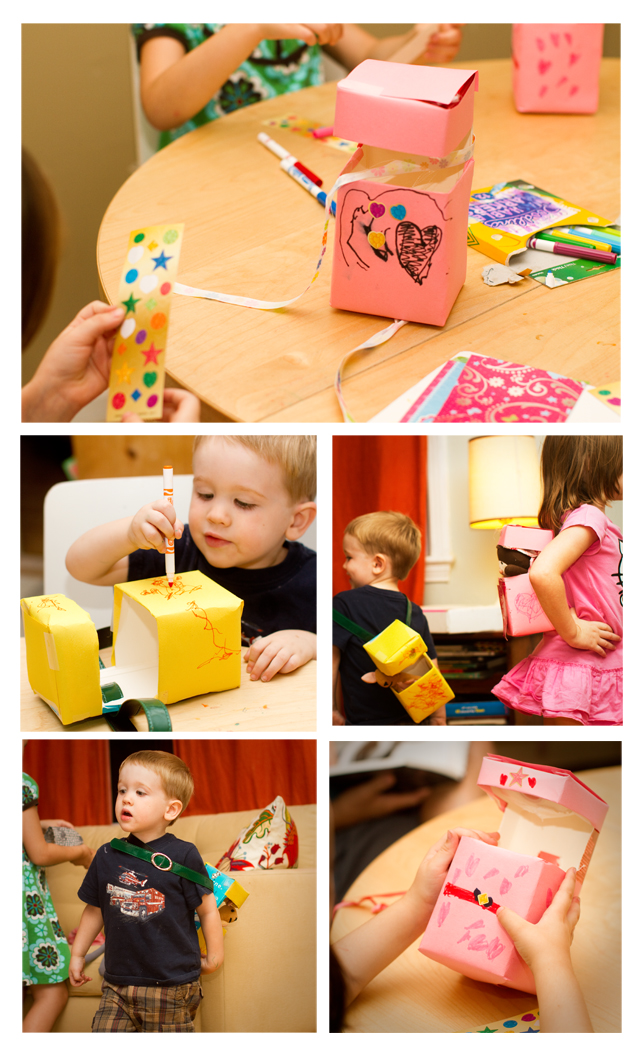
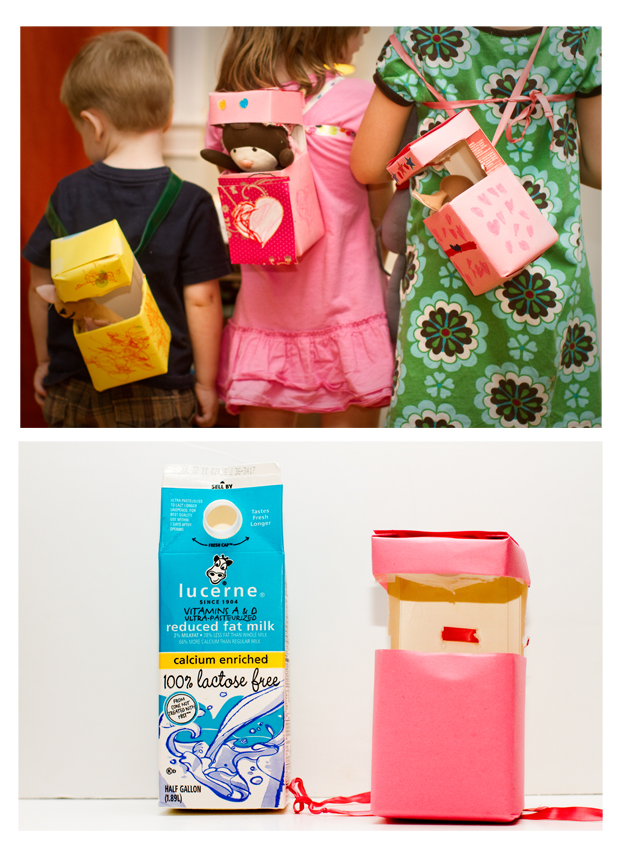
We made these a few weeks ago, but (somewhat astonishingly) they have stuck around. T wears his cradleboard around the house a lot and sometimes on the walk to school. And the girls enjoy taking their stuffed animals for walks in the carriers. After we returned from Mackinac Island the girls wanted to make an American Indian craft (the fort had a lot of exhibits on the island's Native American history), so we perused our favorite craft book, More Than Moccasins: A Kid's Activity Guide to Traditional North American Indian Life (A Kid's Guide series) and the girls insisted that their dolls NEEDED backpack-style carriers.

Here's the scoop:


You'll need: 1/2 gallon milk carton, colored paper, an old belt or ribbon, tape, glue, and scissors

1. Fold and tape down the top of the milk carton so it lays flat.

2. Cut away three sides of the carton (leaving the back) (see attached pictures to see how to make the cuts).

3. Cut two slits in the back of the carton for attaching a belt or ribbon (for T's we used a belt, for the girls' we used ribbon).

4. Cover the sides with construction paper.

5. DECORATE!!

For more Native American crafts and books on Native Americans and Thanksgiving, click here (perfect for thanksgiving).

DON'T FORGET
- tomorrow is the LAST DAY to enter our giveaway for a copy of the Sand Castle CD. Please please take some time to enter. This CD from a local artist is fantastic, trust me, you and your kids will LOVE it. Click here for the info.

OTHER CREATIVE IDEAS FROM AROUND THE WEB:


*I love Under the Pecan Tree's printmaking activity - with paint and q-tips.

*Painting in bottles.

*Cloud dough at Not-So-SAHM looks fun.

*A list of nature activities at Frugal Family Fun, I love the painted sticks and the autumn scavenger hunt list.

*DIY scratch art pages.

make

7/5/11

Things to Make - Story Sticks

stickers

This summer most of our craft projects have been pretty simple, as I'm somewhat exhausted from having all three kids home all day. Plus, T's becoming an erratic napper (yes, I know this is my fault) so I'm never sure if he'll be napping while we create and it isn't easy to come up with great ideas that work for all three ages (5, 4, and 2).

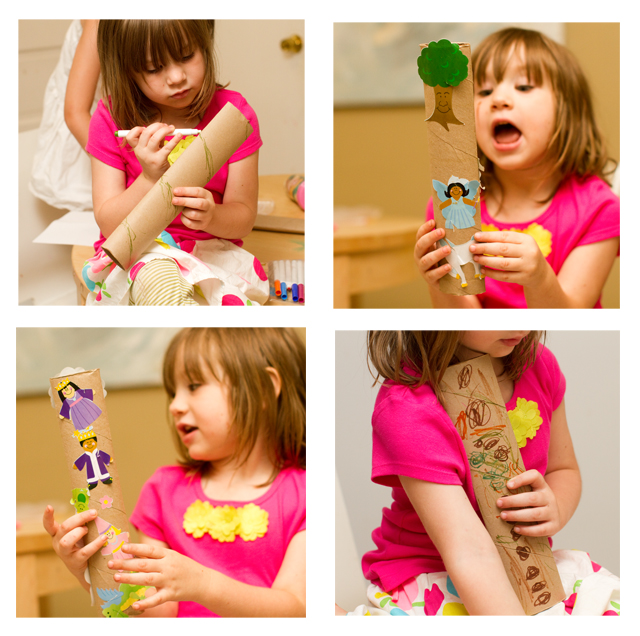
All this being said, a few weeks ago the girls and I made story sticks while T napped and everyone had a blast. We learned about story sticks while perusing my favorite craft book - More Than Moccasins: A Kid's Activity Guide to Traditional North American Indian Life (A Kid's Guide series). According to the book the Pima Indians of Arizona "kept records of things that had happened in their lives on story sticks." The book recommended drawing pictures on tongue depressors but we didn't have any so we used flattened paper towel rolls instead. And I let the girls decide whether or not to base their stories on real events.

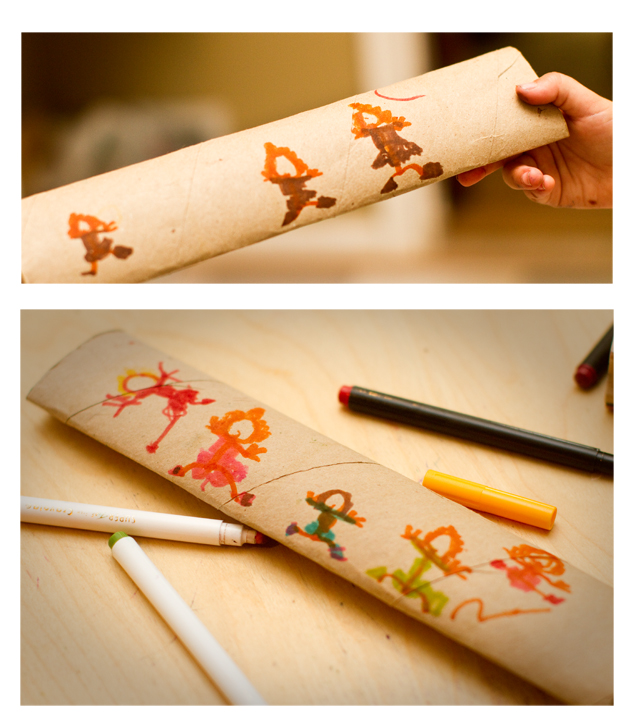
P made two sticks, one told a story involving instruments and mountains and princesses (there's always a princess). For her second stick, P used stickers to tell a long meandering story of a dragon/princess/castle/etc. F, on the other hand, drew a simple but beautiful story of a girl who loved to dance. On one side of the stick she drew pictures of the girl growing up and on the opposite side she drew the dance routine that the girl completed for her big recital.

All in all a fun, easy project that's toddler-friendly. So, had he been awake, T could have participated too.

story

OTHER STORYTELLING IDEAS:

*I LOVE Under the Pecan Tree's story magnet idea. We really need some of these.

*I posted this before but Quirky Mama has a great list of different storytelling activities to do with your children.

*We like using story cards and bare books.

OTHER USES FOR CARDBOARD TUBES:

*A marble run - love this!!

*Our cardboard tube instruments (this post has a long list of other tube ideas too).

*Our post on making doll slides and castles.

*A long snake.

12/30/10

Things to Make - A Pueblo Village

complete
Before you laugh (okay, so while you laugh) remember it is the process not the product.
________________________

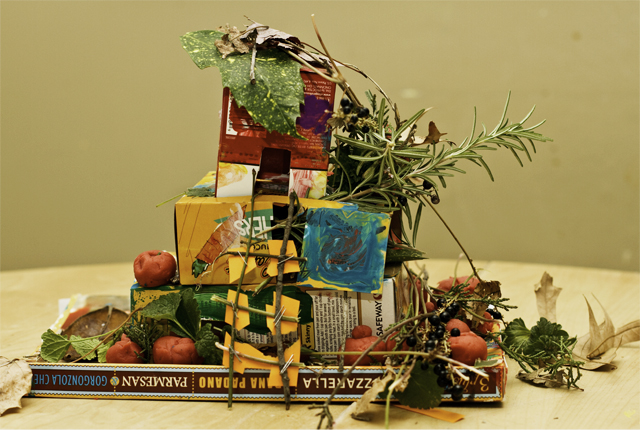
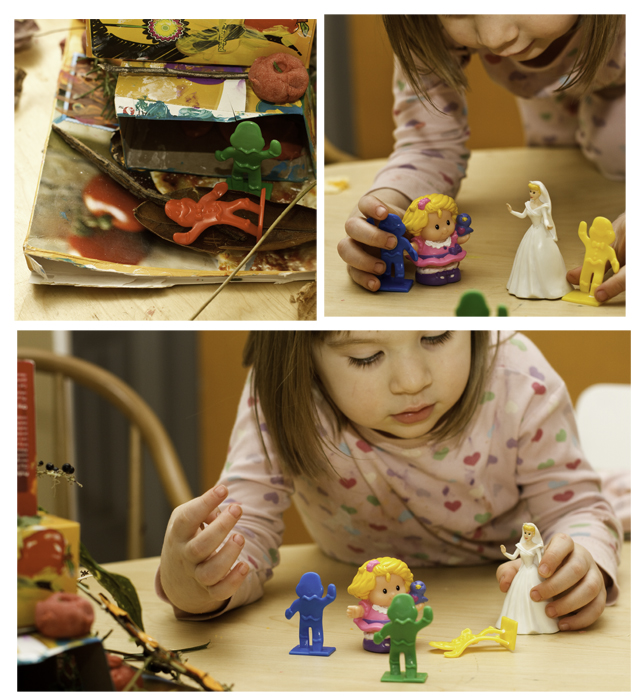
Two weekends ago, T had a fever and my husband had to work, leaving me completely homebound with the kids (without TV, which is an entirely separate story). After a moment of panic and depression, I pulled myself together and thought "all-day craft project?" So I scanned my favorite kids' project book - More Than Moccasins: A Kid's Activity Guide to Traditional North American Indian Life (A Kid's Guide series) (for other posts on the book, click here and here) and tried to find something based on materials we had on hand. After a quick glance of the recycling bin I realized we had enough boxes to make a Pueblo Indian village. Scroll below to see how I made this into an all day task. I'm really proud of us on this one, as we're not usually the best at staying home for long periods of time.

paint
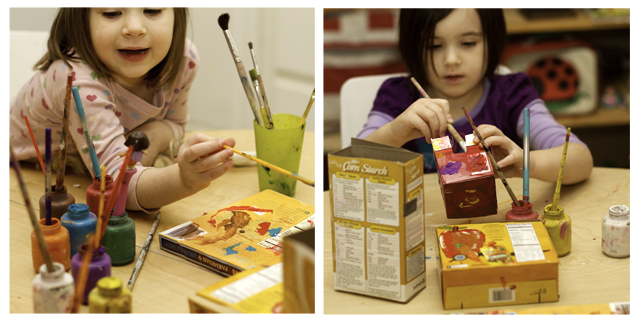
After I cut doors and windows into the boxes the girls painted them. Yes, I'm aware that painting on shiny cardboard is pretty difficult, but sometimes you have to use the materials you have. A more motivated mother may have wrapped the boxes in brown paper first. But I wasn't feeling that motivated.

stick

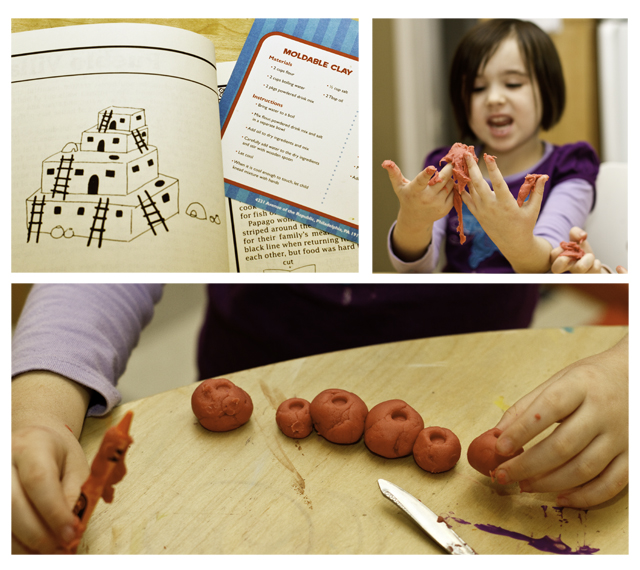
After the girls finished painting I made moldable clay using the recipe photographed above from Philadelphia's Please Touch Museum. Unfortunately, the recipe produced a sticky, hard-to-work-with substance, so I added some cream of tartar and extra flour, which worked much better (cherry koolaid mix made it smell so yummy). I assumed that the moldable dough would somehow be different than playdough (maybe it would dry harder?) but it really wasn't, so I still recommend the easier recipe used here. F then made pots out of the moldable dough. Here's the recipe I used:

*1 and 1/4 cup flour
*1 cup boiling water
*1 pkg powdered drink mix (we used cherry kool-aid)
*1/4 cup salt
*1 tbsp oil
*2 tbsp cream of tartar

*Mix powdered drink mix, flour, and salt. Add oil. Add boiling water and stir with a wooden spoon. Add cream of tartar. Let cool.

outside

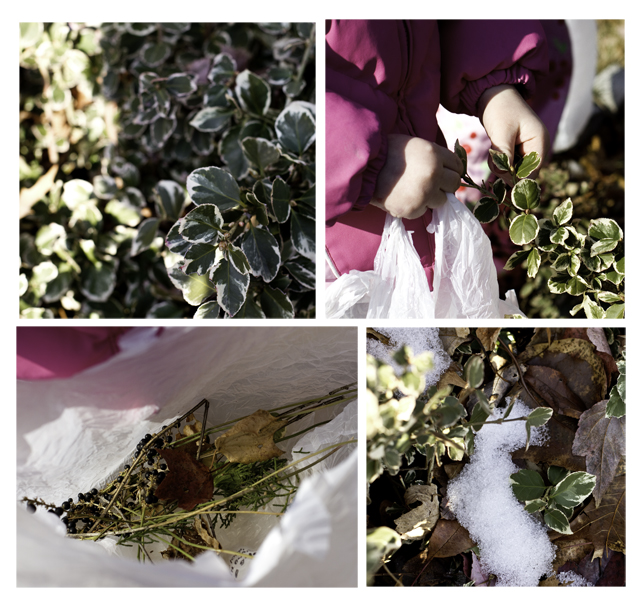
After I put T down for his afternoon nap, the girls and I scavenged outside for natural materials to decorate our house, especially sticks to build ladders. Obviously, as Virginia's climate is completely different from the hot, dry southwest, we dropped any pretense of historical accuracy; except the Pueblo Indians used natural materials and we used natural materials, so at least we kept with the spirit of the project.

decorate

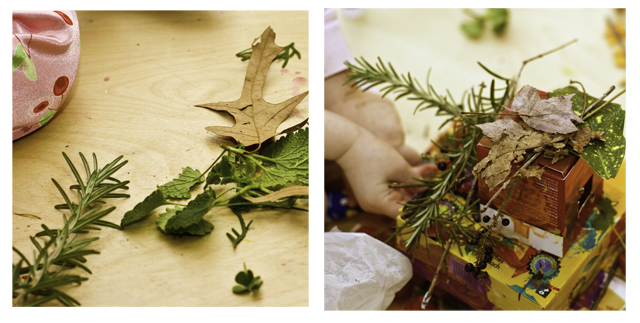
Making a stick ladder proved difficult, dad ended up breaking from work for a little while to help us construct one. We read in our book how the pueblo dwellings had holes in the roof for exit and entry. P thought it important that we use several leaves and branches to hide the holes, in case of enemy invasion. Finally, after much "natural" decorating, we had our own village (see top of this post for the final product).

play

Obviously, we now needed people to live in our village. The small doors eliminated most of the girls' dolls, so we ended up using Candyland game pieces. They seemed to like their new home, though they slept a lot in the leaf hammock pictured above. Then P decided they needed wives and so went the rest of the afternoon.

Obviously our little village was neither historically accurate nor incredibly beautiful, but it kept our day moving along. And hopefully my kids learned a little bit along the way. What about everyone else? Any good ideas for winter sick days?

11/23/10

Things to Make - Teepees & Headbands

teepees

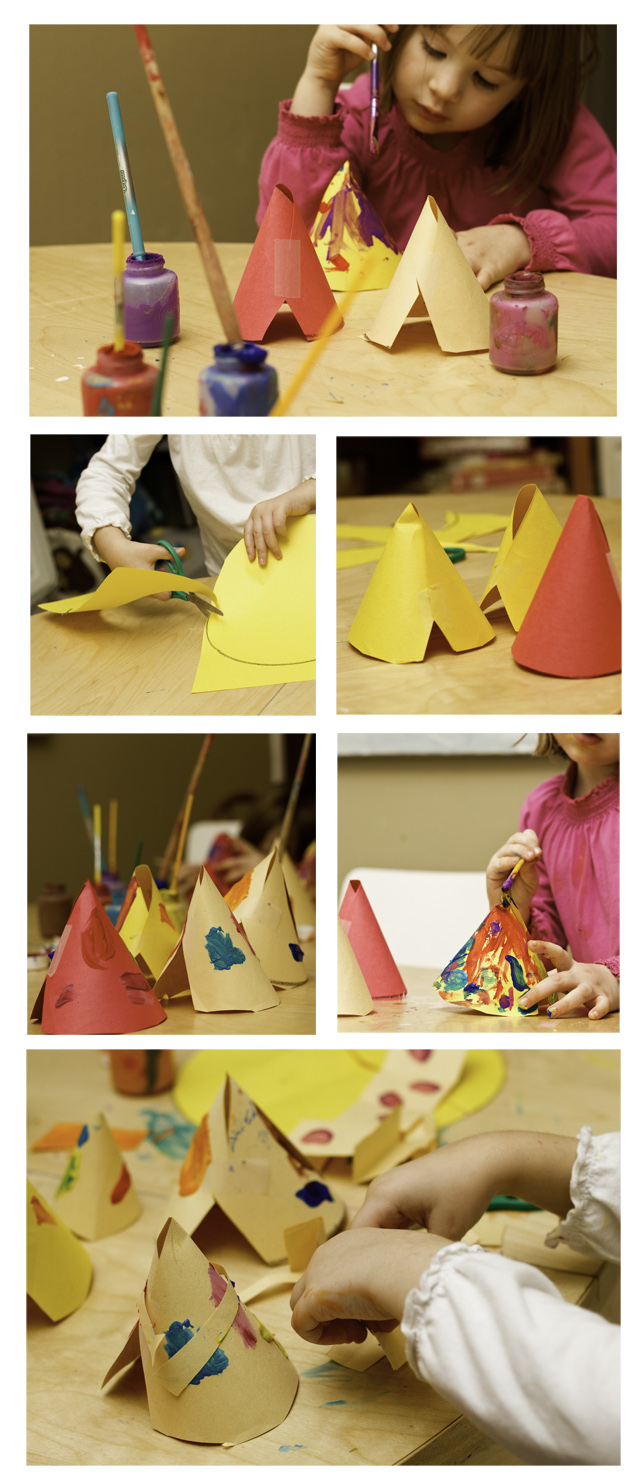
As I mentioned a few weeks ago, lately the girls have been asking a lot of questions about Native Americans, so I bought them a few books on the subject (click here for the post). One of our favorites has been More Than Moccasins: A Kid's Activity Guide to Traditional North American Indian Life (A Kid's Guide series), which is really a great craft book. F's taken to browsing through it in the afternoons and picking out various art/craft projects she wants to try (why do kids always manage to gravitate towards the most complex projects?). So far, we've managed to make teepees and headbands, both of which are incredibly easy (and fun).

To make teepees:
1. Use a bowl to trace a large circle
2. Cut the circle in half
3. Role the half-circle into a cone and tape the ends together (cut out a door or fold back the paper's flaps to make a door)
4. paint or color your teepee (we used 10 ct. 2 oz. Bottles - Assorted Color Washable Kid's Paint).

While crafting, we talked about how the Plains Indians used teepees as portable homes when they hunted buffalo. Our family eats a lot of buffalo (which we buy at farmer's markets through Cibola Farms), so the girls were excited to learn they had this in common with the indians. Though P kept asking why daddy didn't kill our buffalo himself. And of course, we also made paper dolls to live in the teepees, so this project lasted all afternoon. And P now knows not to put any of the villagers (or their homes) on the floor (see here for the back story).
_____________

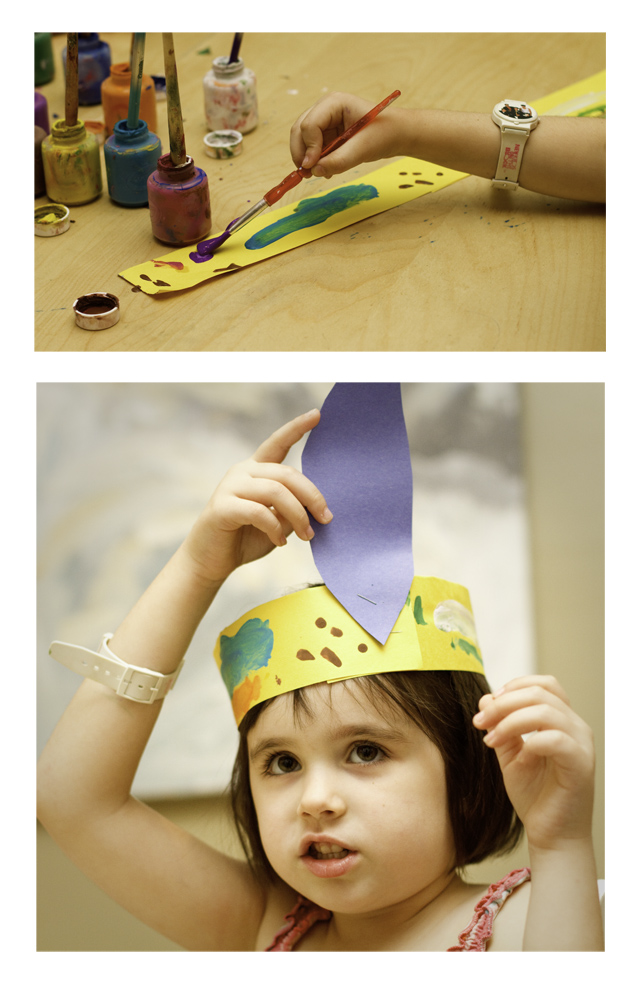
Not surprisingly, one of the first craft projects that F chose was to make a headband (F's already large headband collection continues to grow and grow).

To make headbands:
1. Cut out a long strip of paper (you may need to staple two together) and fit it to your child's head
2. Paint or color the headband, you can also cut out and add other ornaments to the headband (F wanted a feather).

Have a great Tuesday everyone!

headband

In case you're wondering, yes, there is a New Kids On the Block watch on F's wrist. A neighbor gave it to her and it has become a prized piece of jewelry. As long as I don't have to go to the reunion concert, I'm cool with this.

11/11/10

Things to Read - Books for Kids About Thanksgiving & Native Americans

book

As far as holidays go, I'm starting to find Thanksgiving somewhat tricky. On one hand, it's my husband's absolute favorite holiday (he has an adorably cheesy attachment to traditional food and family gatherings). On the other hand, the girls are old enough to ask tough questions about the holiday's origins. Let me approximate one conversation:

P - "So mom, are we going to have Indians at our Thanksgiving?"

F - "No, P, people just PRETEND to be Indians at Thanksgiving. In real life the cowboys kicked all the Indians out of their homes and made them walk so far that they died. Mom, why did the cowboys wear funny hats?"

me - "um, well, actually the pilgrims were the ones with the funny hats. And the cowboys weren't always mean to the Indians, they were just sometimes mean to them. But, sadly, the majority of Indians did die. And now we try to use the term native americans."

F- "So the people with the funny hats were nice to the Indians but then the cowboys came and killed everybody? and what's a native american? Can we invite an indian over for dinner or are they all dead now? Is Pocahontas dead?"

P - "No Pocahontas can't be dead. I saw her on TV. She's so beautiful. I want to be just like her when I become a princess."

F - "P, that wasn't real. That was a cartoon. Things on cartoons aren't real. Pocahontas is dead, the cowboys killed her. Plus, you are born a princess, you don't become a princess. But where are the pilgrims?"

P - "Mommy, F just said I can't be a princess. Tell her she's wrong. When we have an Indian at Thanksgiving can he make me a princess?"

At this point, I tried to change the topic and rushed home to research children's books on native americans and the history of Thanksgiving (as you probably know from reading this blog, books are my answer to all of life's problems). Here's what I found (you can click on the book's thumbnail to link to amazon):

Books about Native Americans for Preschoolers

North American Indians (Pictureback(R))
This book reads like an encyclopedia for children, lots of facts. It covers several different Indian tribes, presenting unique facts about each one. The girls really love looking at the pictures and talking about all the different types of houses and activities. This lead to one of my favorite P quotes ever, "look mom, the Indians even have children. And they play with toys. Just like me." (did she really think they didn't have children?). All in all, this book has been quite a success, we read it almost every night. While it dedicates a few sentences to explaining that Europeans and Indians "fought over land, and many people died . . . [t]he Indians tribes lost most of their land to the settlers," it doesn't make much an effort to explain what happened to the indians (i.e. why there are so few left).

If You Lived With The Cherokees (If You?)
Although the typeset is large and most of the pages have pictures, this book is still MUCH longer (78 pages) than the books my kids usually read. Nevertheless, the girls really seem to like it, probably because it answers so many of their questions - such as: if you were a Cherokee: Would you go to school? What would you celebrate? What jobs would you do? How would you get your name? And, most importantly, it addresses "What happened to the Cherokee when the United States was formed?" AND "What was the Trail of Tears?" As the book explains, "When the Cherokee refused to move, the United States sent 7,000 soldiers to force them out. The soldiers dragged families from their homes, not giving them time to gather their belongings. The Cherokees stood helplessly watching as new settlers took over their homes. They were then forced to live in special fenced camps where many died from filthy conditions." Depressing stuff, but, I believe it's important for my kids to learn the truth about native american history, so I'm glad this book has provided a starting point for us to talk about it. (And, yes, when my kids are old enough, I also plan to read this book to/with them - A Young People's History of the United States, Vol. 1: Columbus to the Spanish-American War).

More Than Moccasins: A Kid's Activity Guide to Traditional North American Indian Life (A Kid's Guide series)
This book just came in the mail (you have to love Amazon prime - which is free for moms right now), so we haven't had a chance to try any of the activities. But I'm really excited. Most of the projects appear manageable, including rattles, games, different food items, and "things to wear." But I'm most excited to create miniature tepees, pueblo villages, and wigmams - i could see these working well for our paper doll family.

Books About Thanksgiving for Preschoolers

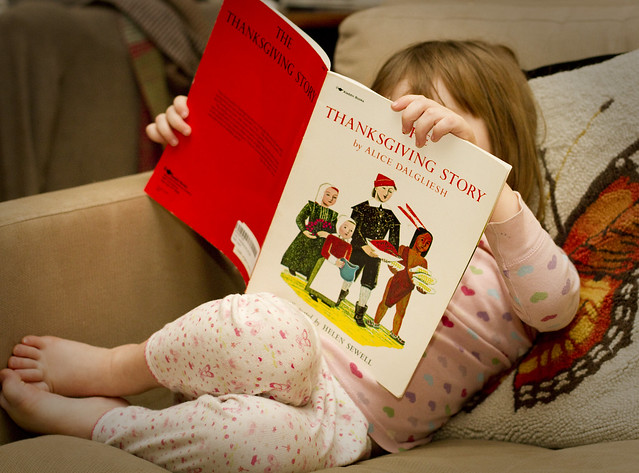
The Thanksgiving Story
First of all, the author wrote this book in 1954, so keep that in mind. The text is a little long-winded (we paraphrase a lot when reading it), but the author does a good job of explaining the tribulations of pilgrim life. As summarized by F, "mom, why do you keep buying us books where lots of people die?" And the book tries, somewhat, to demonstrate the complicated relationship between indians and pilgrims - were they friends? Well, sometimes. My favorite sentence:"Massasoit promised to be friendly. When his people came to Plymouth they would not bring bows and arrows with them. The promise of friendship was kept fifty years." No mention is made of what happened at the end of the fifty years.

One Little, Two Little, Three Little Pilgrims (Picture Puffin Books)
This book is best for YOUNGER children. The writing is bare bones (not many words), but the illustrations are wonderful. At the book's end, the illustrator explains that she researched clothes, table manners, dishes, utensils, hairstyles, etc. of the Wampanoag and Pilgrims. My children really like to look at the pictures and ask questions (many of which the author answers in a "Note From the Author" at the book's end). I HIGHLY RECOMMEND this one.


What about everyone else? I'm really struggling with how best to explain the history of native americans to my children, so any and all suggestions/advice are appreciated. I'm really sad that we missed this festival, but hopefully the National American Indian Museum will host more throughout the year.
LinkWithin

Related Posts Plugin for WordPress, Blogger...